 English
 العربية
 Deutsch
 Español
 Français
 Italiano
 Português
 Русский
 Türkçe
 Tiếng Việt
OKemall Disclaimer Generator — The Complete Guide to Creating a Website Disclaimer
Free Disclaimer Generator — Create a Professional Website Disclaimer Instantly
Introduction
You publish a blog post reviewing the best laptops for developers. A reader buys one based on your recommendation, and it breaks after two weeks. You run a fitness website with workout advice, and someone injures themselves following your routine. You link to third-party products in your newsletter, and a reader feels misled when the product page changes without your knowledge.
In each of these situations, a properly written disclaimer is the document that stands between you and potential legal trouble. It tells your readers, clearly and upfront, that your content is for informational purposes, that you are not liable for how they use it, and that they should do their own due diligence before making decisions based on your advice.
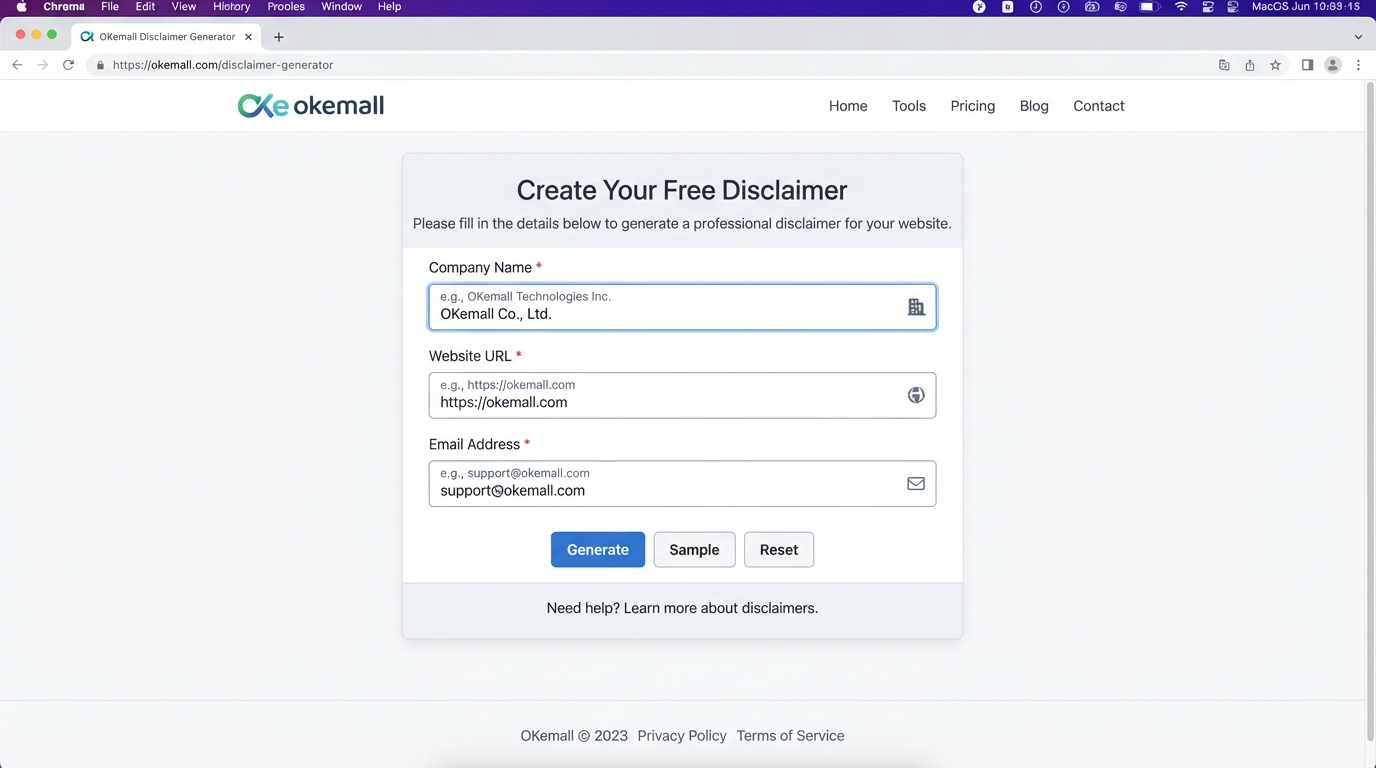
The OKemall Disclaimer Generator creates this protection in seconds. Enter your company name, your website URL, and your email address, and it generates a complete, professional disclaimer document ready for review and publication on your website.
In this guide — the final piece in our legal document trilogy following the Terms and Conditions and Privacy Policy generators — we will explore why disclaimers matter, which types you might need, how to use the generator step by step, and how disclaimers fit alongside Terms and Privacy Policies in a complete legal framework.
What a Disclaimer Actually Protects You From
A disclaimer is not the same as Terms and Conditions or a Privacy Policy. Here is what sets it apart:
Terms and Conditions define the rules users must follow — what they can and cannot do on your site, your intellectual property rights, account termination policies, and refund terms.
Privacy Policy explains how you collect, use, store, and share personal data — cookies, email addresses, analytics, and third-party services.
A Disclaimer limits your legal liability for the content you publish. It tells readers: "The information on this site is for general informational purposes only. I am not a lawyer, doctor, financial advisor, or licensed professional. Use this information at your own risk."
Specifically, a well-written disclaimer addresses five areas of liability:
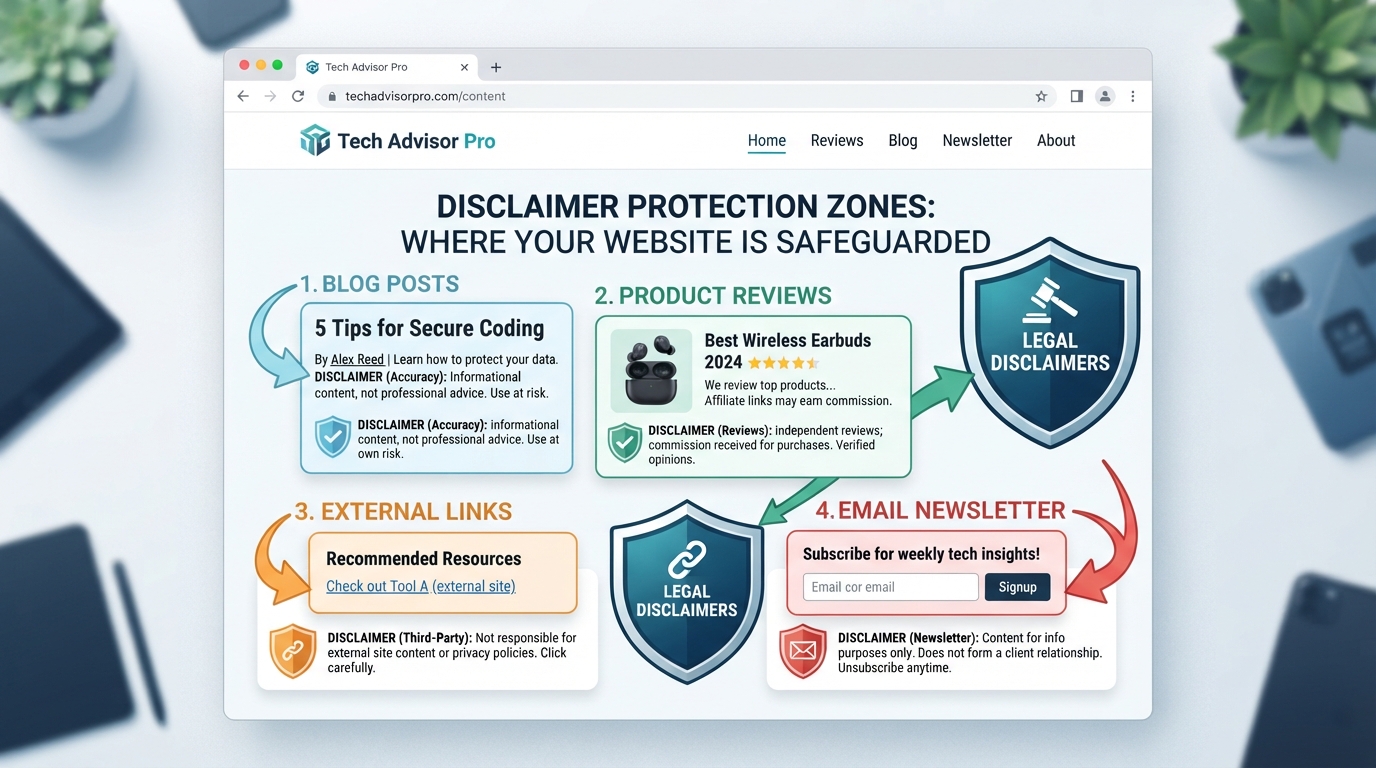
1. Informational content liability. Most websites publish information — blog posts, guides, tutorials, opinion pieces. A disclaimer clarifies that this content does not constitute professional advice and that the site owner is not responsible for outcomes resulting from a reader's reliance on that information.
2. Affiliate and sponsored content. If you earn commissions through affiliate links (Amazon Associates, ShareASale, Impact) or publish sponsored posts, the FTC and similar regulatory bodies worldwide require clear disclosure. Your disclaimer should explicitly state that you may earn a commission at no additional cost to the reader.
3. Third-party links. When you link to external websites, products, or services, you do not control what happens on those pages. A disclaimer notes that you are not responsible for the content, accuracy, or practices of third-party sites.
4. Errors and omissions. Information changes. Prices update. Products get discontinued. A disclaimer acknowledges that your content may contain inaccuracies, that it represents your best knowledge at the time of publication, and that readers should verify critical information independently.
5. Personal opinions. Your blog posts, reviews, and social media content represent your personal views — not the views of your employer, your clients, or any organization you are associated with. A disclaimer formally separates your personal content from any institutional affiliation.
Types of Disclaimers You Might Need
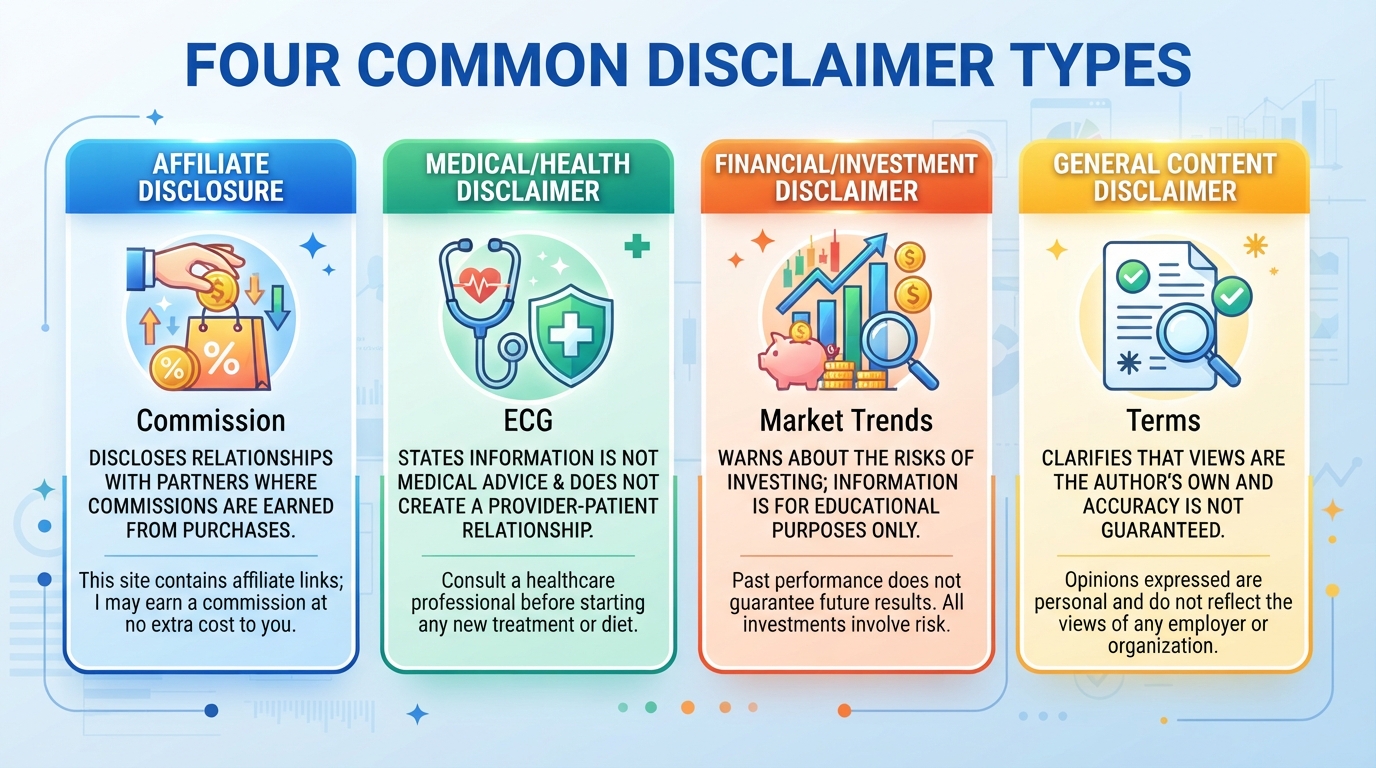
Not every website needs every type of disclaimer. Here are the most common categories and which sites need them:
Affiliate Disclaimer (FTC Compliance)
If you use affiliate links on your website — Amazon Associates, ShareASale, ClickBank, partner programs, or any arrangement where you earn a commission — you are legally required in the United States (and in many other countries) to disclose that relationship. The FTC's Endorsement Guidelines require this disclosure to be "clear and conspicuous," meaning it should appear near your affiliate content, not buried in a page nobody reads.
Best for: Review sites, deal blogs, coupon sites, comparison sites, any blog with affiliate links.
Medical and Health Disclaimer
If your website publishes content about health, fitness, nutrition, mental health, supplements, or medical conditions, you need a disclaimer stating that your content is not a substitute for professional medical advice. Without one, a reader who acts on your content and experiences a negative health outcome may have grounds for legal action.
Best for: Fitness blogs, nutrition websites, supplement review sites, mental health blogs, wellness content.
Financial and Investment Disclaimer
Websites covering stocks, cryptocurrency, investing strategies, personal finance, or tax advice are in a high-risk category. Financial regulators take investment advice seriously, and even casual statements like "this stock is a buy" can attract regulatory attention. A disclaimer clarifying that your content is for informational purposes only — not financial advice — is non-negotiable.
Best for: Investment blogs, crypto content, personal finance sites, trading signal services, tax-related content.
Legal Disclaimer
If your website discusses legal topics (even casually), a disclaimer clarifies that your content is not legal advice and that readers should consult a qualified attorney for their specific situation. This is especially important if your content could be interpreted as guidance on contracts, business formation, intellectual property, or compliance.
Best for: Legal blogs, business advice sites, contract template sites, compliance content.
General Content Disclaimer
Even if none of the above categories apply, every website benefits from a general disclaimer covering informational content, errors and omissions, personal opinions, and third-party links. This is the broadest category and applies to virtually all websites.
Best for: All websites, blogs, portfolios, small business sites.
How to Use the OKemall Disclaimer Generator: Step-by-Step
Step 1: Enter your company name. Type the legal name or official business name associated with the website. If you are a sole proprietor, use your personal name or registered DBA (Doing Business As). This name appears as the responsible entity throughout the generated disclaimer.
Step 2: Enter your website URL. Type the complete web address, including the protocol: https://www.yourdomain.com. The URL is referenced in the disclaimer as the subject website to which the liability limitations apply.
Step 3: Enter your email address. Provide a contact email where users can reach you with questions or concerns about the disclaimer or your content. This creates a clear channel for communication and demonstrates that you are reachable — a factor that can matter in legal disputes.
Step 4: Choose your action. Click one of three buttons:
- Generate — Creates a customized disclaimer populated with your company name, URL, and email. The text appears in a result area ready for review.
- Sample — Loads pre-filled example data to demonstrate the output format and structure without committing your actual business details. Use this first if you want to understand what the generated disclaimer looks like before generating your own.
- Reset — Clears all three input fields for a fresh start.
Step 5: Review and customize. The generated disclaimer covers the broad protections discussed above, but you must review it for your specific content. If you run a fitness blog, strengthen the health-related language. If you use affiliate links, ensure the disclosure is prominent. If you publish financial content, add explicit investment risk language.
Step 6: Copy and publish. The tool includes a copy-to-clipboard function. Create a dedicated page on your website (typically at yourdomain.com/disclaimer), paste the content, customize the formatting, and publish. Link to it from your website footer alongside your Terms and Conditions and Privacy Policy.
Where Disclaimers Provide Protection
A disclaimer is only effective if users can find it. Here are the places where your disclaimer should be visible or referenced:
Website footer. Every page of your site should include a footer link to your Disclaimer, Privacy Policy, and Terms and Conditions. This is the standard practice across the web and the minimum expected in any legal review.
Blog post footers. If you publish affiliate content or advice-based articles, add a short notice at the bottom of each relevant post — something like: "Disclosure: This post contains affiliate links. I may earn a commission at no additional cost to you. All opinions are my own."
Email newsletters. If your newsletter includes affiliate links or sponsored content, include a brief disclosure in the footer of every email.
Social media bios. If you primarily publish content through social media, include a link to your full disclaimer in your bio or about section.
How the Disclaimer Completes the Legal Document Trio
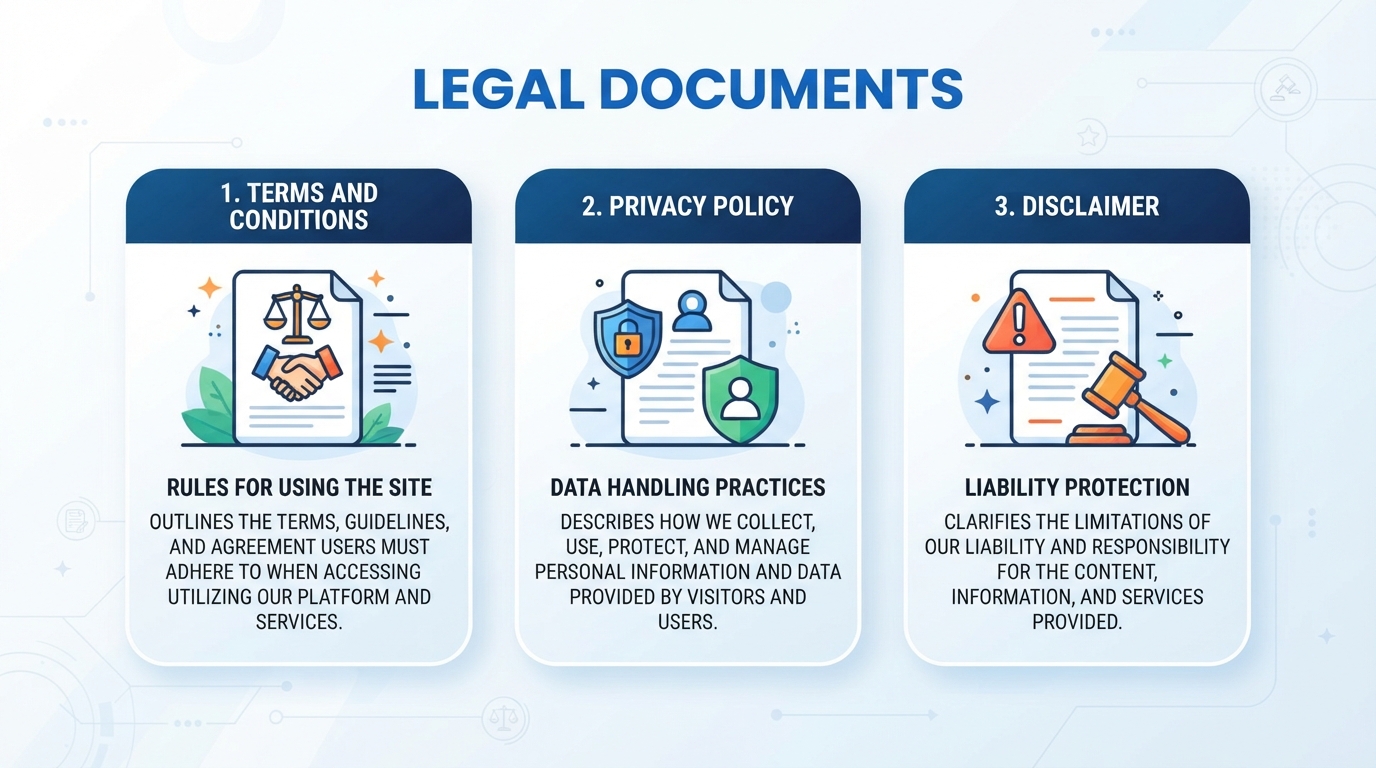
The OKemall platform provides all three essential website legal documents, each serving a distinct and complementary purpose:
| Document | What It Does | Example Clause |
|---|---|---|
| Terms and Conditions | Governs user behavior and defines the legal relationship | "By using this website, you agree to be bound by these terms." |
| Privacy Policy | Explains data collection, storage, and sharing | "We use cookies to analyze traffic and improve your experience." |
| Disclaimer | Limits liability for published content | "The information on this site is for general informational purposes only." |
Generate all three:
- Start with the Terms And Condition Generator — Establish the rules of engagement.
- Follow with the Privacy Policy Generator — Disclose your data practices.
- Complete with the Disclaimer Generator — Protect yourself from content liability.
Publish all three pages, link them together in your footer, and you have a solid legal foundation for your website.
What Makes OKemall's Disclaimer Generator Stand Out
Three-field simplicity. Company name, website URL, and email address — three inputs produce a complete disclaimer. No legal knowledge required.
Part of a complete legal suite. The Disclaimer Generator is the third pillar alongside the Terms and Conditions Generator and Privacy Policy Generator. Generate all three from the same platform.
Sample button for preview. Test the tool with placeholder data before entering real business information. Understand the output format and coverage areas without commitment.
Copy-to-clipboard functionality. A dedicated copy button selects the entire generated disclaimer text for quick pasting into your website.
No registration required. Generate, review, customize, and publish — no signup, no email collection, no payment.
Email contact integration. Unlike many disclaimer generators that produce anonymous, email-free templates, the OKemall tool embeds your contact email — giving users a clear communication channel and demonstrating that you are reachable.
Mobile-friendly and multi-language. Available in 10 languages, fully responsive.
Pro Tips for Publishing Your Disclaimer
1. Do not bury it. A disclaimer hidden three clicks deep offers little protection. Link to it from your website footer on every page, just as you do for your Privacy Policy and Terms. If a judge sees that your disclaimer was easily accessible, that strengthens your legal position.
2. Customize for your specific content. The generator produces a broad, general disclaimer. Strengthen specific sections based on your content. If you publish health advice, add explicit medical disclaimer language. If you use affiliate links, make the disclosure more prominent. The generator gives you the foundation — your customization makes it relevant.
3. Add a "Last Updated" date. Disclaimers, like other legal documents, should carry a date stamp. When you publish or update your disclaimer, add the date. This creates a record of when the protection was in effect.
4. Reference your other legal pages. In your disclaimer, link to your Terms and Conditions and Privacy Policy. In those documents, link back to your disclaimer. Cross-linking creates a cohesive legal framework and demonstrates that the documents work together.
5. Keep it current. Review your disclaimer every 6–12 months — or whenever your content strategy changes significantly. If you start using affiliate links, add affiliate disclosure language. If you start publishing investment content, add financial disclaimer language. Your disclaimer should grow as your content grows.
6. Do not over-rely on disclaimers. A disclaimer limits liability — it does not eliminate it. If you knowingly publish false information, intentionally mislead readers, or engage in fraudulent practices, no disclaimer will protect you. Disclaimers are a shield, not a license for misconduct.

Frequently Asked Questions
Q: Is the OKemall Disclaimer Generator free? Yes, completely free. No signup, no registration, no usage limits.
Q: Do I need a disclaimer if I already have Terms and Conditions? Yes. Terms and Conditions govern user behavior and define the legal relationship. A disclaimer specifically limits your liability for the accuracy and outcomes of your published content. They serve different purposes.
Q: Will a disclaimer completely protect me from lawsuits? No legal document can completely prevent lawsuits. A disclaimer limits your liability by clearly communicating that your content is informational, not professional advice, and that readers use it at their own risk. It is an important layer of protection, but it is not absolute immunity.
Q: Do I need an affiliate disclaimer if I only link to Amazon products? Yes. Both the FTC guidelines and Amazon's Associates Program terms of service require you to clearly disclose affiliate relationships. A dedicated affiliate disclosure — either within your main disclaimer or as a separate notice — satisfies both requirements.
Q: Is the generated disclaimer enough for a medical or financial website? The generator provides a strong foundation, but high-risk categories (health, finance, legal) benefit from specialized language beyond what a general template provides. Use the generated disclaimer as a starting point, then strengthen the relevant sections with category-specific language. For high-risk websites, consulting a lawyer is recommended.
Q: Does the generated disclaimer include all the clauses I need? The generator covers the most commonly needed disclaimer clauses — informational content, errors and omissions, third-party links, personal opinions, and general liability limitation. You should review the output and add clauses specific to your content (affiliate disclosure, health warnings, investment risk statements).
Q: Where should I publish the disclaimer? Create a dedicated page (typically /disclaimer) and link to it from your website footer on every page. If you have specific high-liability content (affiliate posts, health advice), also add inline disclosures within those individual articles.
Q: Does the tool work on mobile? Yes, the interface is fully responsive.
A disclaimer is the quietest of the three legal documents every website needs — less prominent than Terms and Conditions, less regulated than a Privacy Policy — but in many ways, it is the one most likely to be invoked when something goes wrong. A reader who acts on your fitness advice and gets injured. A customer who buys a product through your affiliate link and is dissatisfied. A visitor who follows your tutorial and loses data. In each case, your disclaimer is the document they will point to — and the document you will point to in response.
The OKemall Disclaimer Generator makes creating this protection effortless. Three inputs — company name, website URL, and email address — produce a complete, professional disclaimer covering informational content, errors and omissions, third-party links, and personal opinions. Combined with the Terms and Conditions and Privacy Policy generators, you can publish a complete triad of legal protection for your website in under an hour.
Review the generated text. Customize it for your specific content and risk profile. Publish it where readers can find it. And sleep better knowing that you have clearly, publicly, and fairly communicated the limits of your responsibility.
Protect your content and limit your liability. Try the OKemall Disclaimer Generator now — the final pillar in your website's legal foundation, free and ready when you are.

Popular Tools
Recent Posts