 English
 العربية
 Deutsch
 Español
 Français
 Italiano
 Português
 Русский
 Türkçe
 Tiếng Việt
OKemall Charge Converter — Convert Electric Charge Units Instantly
Free Online Charge Converter — Convert Coulombs, Ampere-Hours, Faraday & More
Electric charge is one of the fundamental quantities in physics and electrical engineering — as fundamental as length, mass, and time. But unlike length (meters) or mass (kilograms), charge comes in an unusually wide variety of units depending on the field of application. Physics textbooks use coulombs. Battery specifications use ampere-hours. Electrochemistry uses faradays. Nuclear physics uses elementary charge. Older electromagnetic unit systems use statcoulombs and abcoulombs.
Converting between these systems manually means working with conversion factors like 1 ampere-hour = 3,600 coulombs, 1 faraday ≈ 96,485.33212 coulombs, or 1 elementary charge ≈ 1.602176634 × 10⁻¹⁹ coulombs. These are not numbers anyone should be calculating in their head or entering into a basic calculator by hand.
The OKemall Charge Converter handles all 17 major electric charge units in a single tool. Enter a value, select the source unit from the dropdown, click Convert, and get instant results across every other unit. No conversion factors, no exponential notation errors, no unit system confusion.
In this guide, we will explore the 17 supported charge units, explain when each one is used, and show you how to integrate the Charge Converter into your physics, engineering, and electronics workflow.
The 17 Electric Charge Units Explained
The OKemall Charge Converter supports three categories of charge units: SI (the modern international system), CGS (the older centimeter-gram-second electromagnetic system), and practical units used in battery and electrochemistry applications.
SI Units (International System)
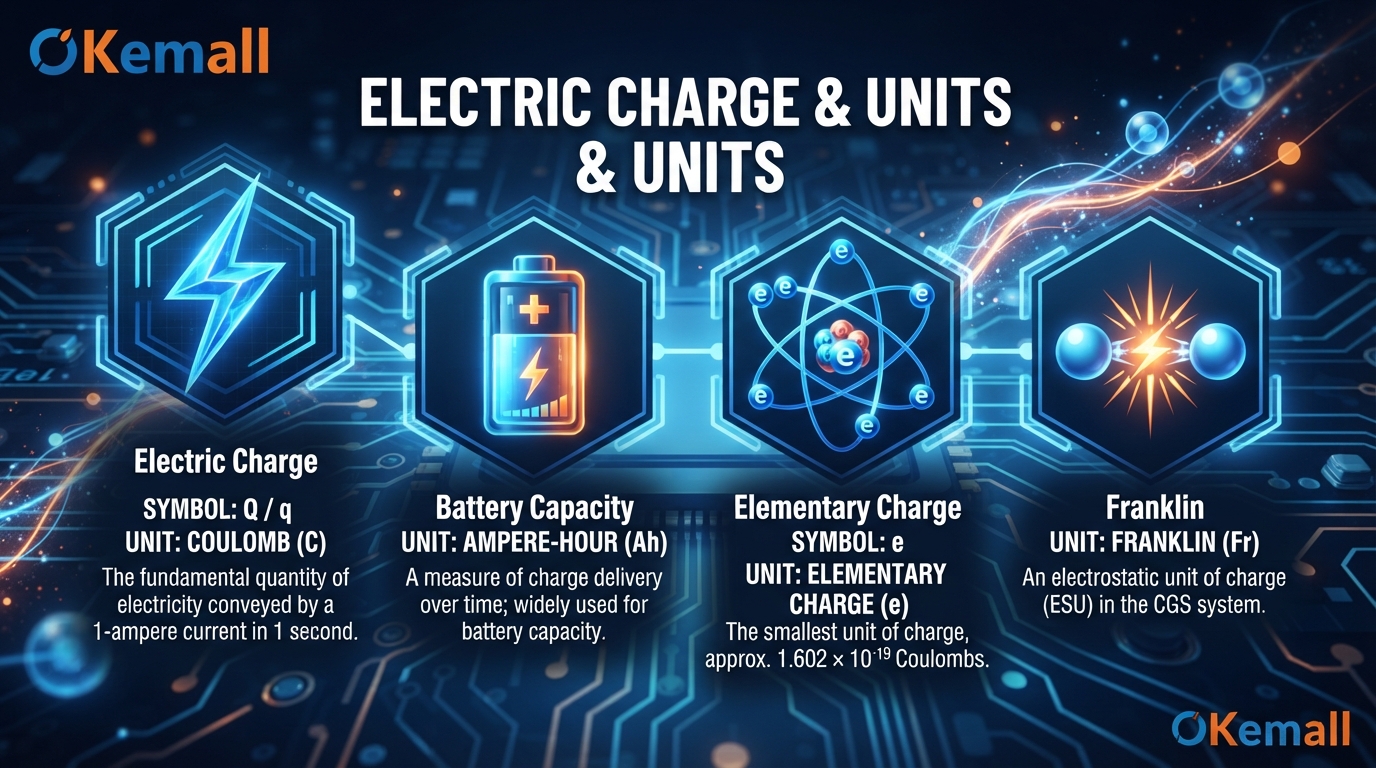
Coulomb (C): The SI base unit of electric charge. One coulomb is defined as the charge transported by a constant current of one ampere in one second. It is the default unit in the converter and the reference point for all other units.
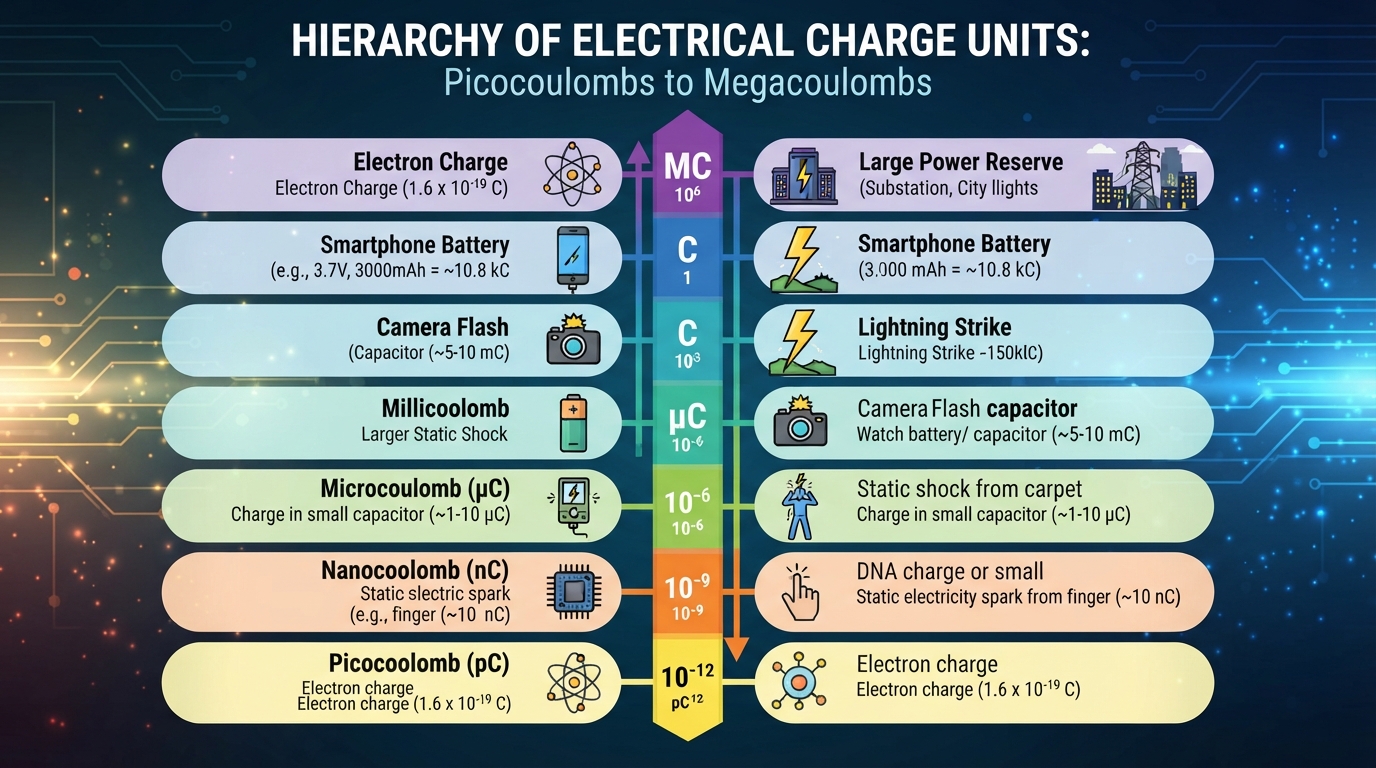
Megacoulomb (MC): 1,000,000 coulombs (10⁶ C). Used in large-scale electrical engineering calculations involving massive charge transfers, such as lightning strikes (a typical lightning bolt transfers 15–350 C) or industrial capacitor banks.
Kilocoulomb (kC): 1,000 coulombs (10³ C). A convenient mid-scale unit between laboratory-scale coulombs and industrial-scale megacoulombs.
Millicoulomb (mC): 0.001 coulombs (10⁻³ C). Common in electronics and small-scale experiments where nano- and microcoulombs are still too small.
Microcoulomb (µC): 10⁻⁶ coulombs. Standard in electrostatic experiments, capacitor charge measurements in circuits, and undergraduate physics labs.
Nanocoulomb (nC): 10⁻⁹ coulombs. Used in semiconductor physics, MEMS devices, and precise charge measurement applications.
Picocoulomb (pC): 10⁻¹² coulombs. Used in high-precision physics experiments, ion detection, and sensitive electronic measurements where individual charge events are measured.
CGS Electromagnetic Units
Abcoulomb (abC): Also called the electromagnetic unit of charge (emu). 1 abcoulomb = 10 coulombs. Used in the CGS electromagnetic unit system, primarily in older physics texts and specific magnetohydrodynamics applications.
EMU of charge: Equivalent to the abcoulomb. The CGS electromagnetic unit system's base charge unit. One EMU of charge = 10 coulombs.
Statcoulomb (stC): Also called the electrostatic unit of charge (esu) or franklin. 1 statcoulomb ≈ 3.33564 × 10⁻¹⁰ coulombs. Used in the CGS electrostatic unit system and still appears in some theoretical physics and electrodynamics texts.
ESU of charge: Equivalent to the statcoulomb. The CGS electrostatic unit system's base charge unit.
Franklin (Fr): Another name for the statcoulomb/esu, named after Benjamin Franklin. Used primarily in historical and theoretical contexts within the CGS electrostatic system.
Practical and Derived Units
Ampere-hour (A·h): The charge transferred by one ampere of current flowing for one hour. 1 A·h = 3,600 coulombs. This is the standard unit for battery capacity — your phone battery, laptop battery, and EV battery are all rated in ampere-hours (or milliampere-hours, mAh).
Ampere-minute (A·min): The charge transferred by one ampere in one minute. 1 A·min = 60 coulombs. Occasionally used in electroplating and electrochemistry where coulombs are too small and ampere-hours are too large.
Ampere-second (A·s): Equivalent to one coulomb. Sometimes used to emphasize the current-time relationship in electrical engineering contexts.
Faraday (carbon 12): The charge of one mole of electrons. 1 faraday ≈ 96,485.33212 coulombs. This is a fundamental constant in electrochemistry used to calculate the amount of substance produced in electrolysis. Named after Michael Faraday, it is essential in battery design, electroplating, and fuel cell engineering.
Elementary charge (e): The charge of a single proton (or the magnitude of charge of a single electron). Exactly 1.602176634 × 10⁻¹⁹ coulombs (as redefined in the 2019 SI revision). This is the fundamental quantum of charge — all observable charges are integer multiples of e. Used in particle physics, quantum mechanics, and semiconductor physics.
Why Unit Systems Matter in Charge Conversion
Electric charge is unusual among physical quantities because it has been measured in three completely different unit systems — and all three are still in active use:
SI (International System): Centered on the coulomb. Used by all modern engineering, physics education, and industry. The ampere is now the defining SI base unit (not the coulomb), with 1 C defined as 1 A × 1 s.
CGS Electrostatic (esu): Centered on the statcoulomb/franklin. Defined by Coulomb's law in the CGS system. Still appears in theoretical electrodynamics, astrophysics, and some older semiconductor physics texts.
CGS Electromagnetic (emu): Centered on the abcoulomb. Defined by Ampère's force law in the CGS system. Used historically in magnetostatics and still referenced in certain specialized engineering fields.
Converting between these systems requires knowing the speed of light (c ≈ 2.998 × 10¹⁰ cm/s in CGS, or 299,792,458 m/s in SI), because the relationship between esu and emu units is defined by c: 1 abcoulomb = c statcoulombs. The OKemall Charge Converter handles this cross-system conversion automatically — you never need to look up c or apply these relationships manually.
How to Use the OKemall Charge Converter: Step-by-Step
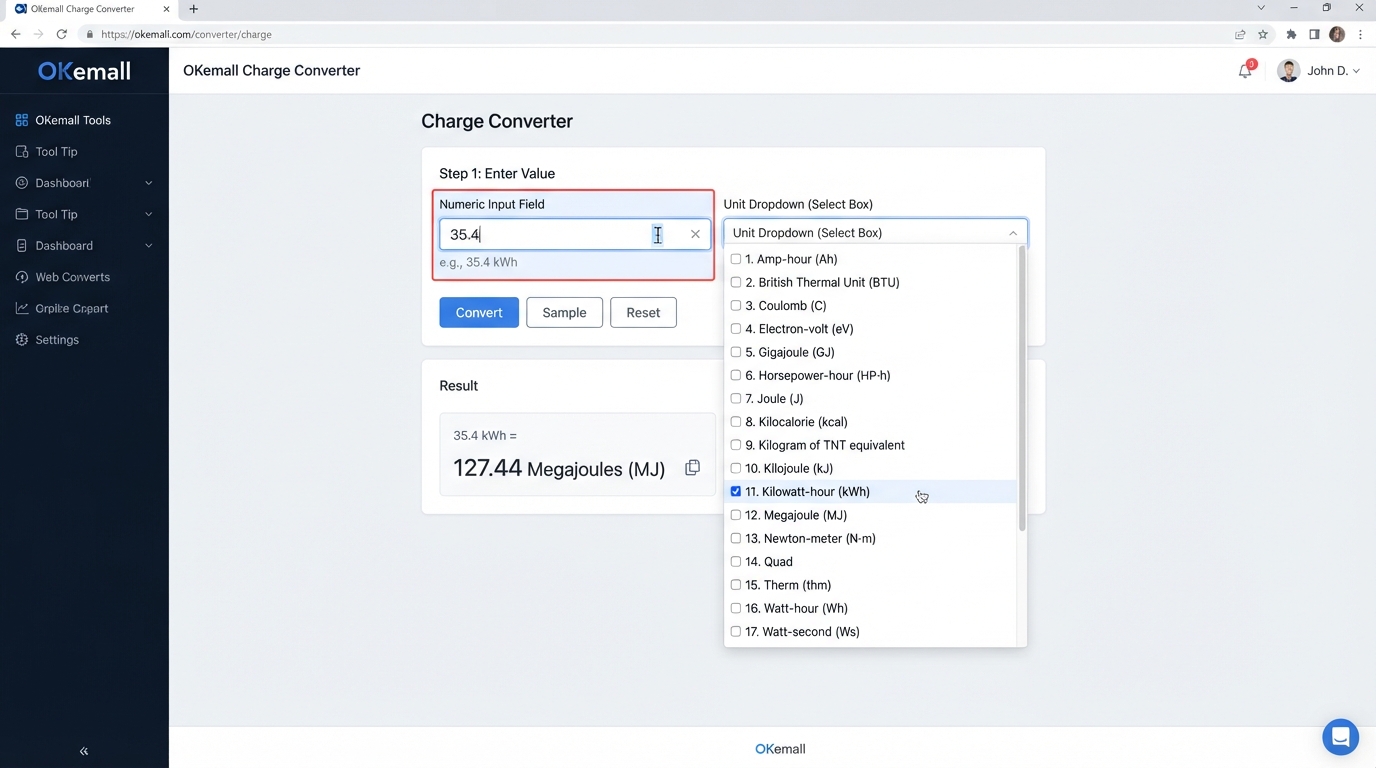
Step 1: Enter a numeric value. Type any number into the "Value" field. Enter whole numbers or decimals — the field accepts both.
Step 2: Select the source unit. Use the dropdown labeled "Convert From Coulomb to Others" to choose the unit of your input value. The default is coulomb (C). You can select any of 17 units ranging from picocoulomb (pC) to megacoulomb (MC), including CGS units (statcoulomb, abcoulomb) and practical units (ampere-hour, faraday, elementary charge).
Step 3: Click "Convert." The results display the equivalent value in all other 16 units. Scan the output for the unit you need.
Step 4 (optional): Click "Sample" to load a random example value, or "Reset" to clear everything.
What Makes OKemall's Charge Converter Stand Out
17 units across three unit systems. Unlike basic converters that only handle coulombs and a few SI prefixes, the OKemall tool includes the full CGS electromagnetic system (abcoulomb, EMU), CGS electrostatic system (statcoulomb, ESU, franklin), and practical units (ampere-hour, ampere-minute, faraday, elementary charge).
Cross-system conversion. The tool automatically handles conversions between SI, CGS-esu, and CGS-emu using the correct physical relationships. You can convert statcoulombs to coulombs, elementary charge to ampere-hours, or faradays to millicoulombs without looking up a single constant.
Decimal-friendly input. The field accepts any numeric value, including scientific quantities like the elementary charge (1.602176634e-19) or battery capacities (5000 mAh expressed as 5 Ah).
No registration required. Open the page and convert immediately. No signup, no limits.
Mobile-friendly and multi-language. Works on all devices, available in 10 languages.
Common Charge Conversion Scenarios
| Scenario | Convert From | Convert To | Why |
|---|---|---|---|
| Battery capacity to physics units | Ampere-hour | Coulomb | 5,000 mAh = 5 Ah = 18,000 C |
| Physics problem in esu units | Statcoulomb | Coulomb | Cross-check results across unit systems |
| Electroplating calculations | Faraday | Coulomb | Calculate charge needed for metal deposition |
| Particle physics | Elementary charge | Coulomb | Scale from quantum to macroscopic charge |
| Engineering capacitor design | Microcoulomb | Coulomb | Check specifications against datasheet values |
| EV battery total charge | Ampere-hour | Megacoulomb | Large-scale charge for vehicle range calculations |
Related OKemall Converter Tools
The Charge Converter is part of a suite of unit conversion tools on OKemall:
- Length Converter — Length and distance units.
- Area Converter — Surface area units.
- Volume Converter — Volume and capacity units.
- Weight Converter — Mass and weight units.
- Temperature Converter — Temperature scale conversions.
- Time Converter — Time units from picoseconds to years.
- Angle Converter — Degree, radian, and gradian conversions.
- Currency Converter — Live exchange rate conversions.
Frequently Asked Questions
Q: Is the OKemall Charge Converter free? Yes, completely free. No signup, no limits.
Q: What is the difference between a statcoulomb and a coulomb? They belong to different unit systems. The coulomb is the SI unit; the statcoulomb is the CGS electrostatic unit. 1 statcoulomb ≈ 3.33564 × 10⁻¹⁰ coulombs. The physical charge is the same — the unit used to express it differs.
Q: Why does the converter include ampere-hours? Ampere-hours are the standard unit for battery capacity. Converting battery ratings (in Ah or mAh) to coulombs is a common need in electrical engineering and physics. 1 Ah = 3,600 C.
Q: What is a faraday used for? The faraday is used in electrochemistry to relate electrical charge to chemical amounts. One faraday of charge electrolyzes one mole of a monovalent substance. It is essential in battery design, electroplating, and fuel cell calculations.
Q: What is the elementary charge? The elementary charge (e) is the charge of a single proton. It is the smallest freely observed unit of electric charge. All everyday charges are integer multiples of e. It is a fundamental physical constant used in quantum mechanics and particle physics.
Q: Does the tool work on mobile? Yes, fully responsive.
Electric charge spans an extraordinary range — from the picocoulombs measured in sensitive physics detectors to the megacoulombs involved in industrial energy storage and lightning strikes. It bridges three distinct unit systems, each with its own conventions, and serves as the foundation for everything from battery specifications to quantum mechanics.
The OKemall Charge Converter collapses all 17 units and all three unit systems into a single tool. Enter a value, select a source unit, and get accurate conversions across every other unit — SI, CGS, and practical — instantly. Whether you are solving a physics problem in statcoulombs, converting a battery's ampere-hour rating to coulombs, or calculating faraday equivalents for an electroplating setup, this is the tool that handles the math so you do not have to.
Converting electric charge should be the easiest part of your physics or engineering work. Try the OKemall Charge Converter now — 17 units, free, and always ready.