UUID Generator: Generate Unique IDs Online Free
Generate Unique IDs Online and Understand How UUIDs Work
Modern software applications create an enormous number of records every day. Users register accounts, products are added to databases, orders are created, files are uploaded, API requests are processed, and individual objects need to be identified reliably.
A simple numeric ID such as 1, 2, 3, or 1001 can work for a small database. As applications become larger or distributed across multiple systems, developers often need identifiers that can be generated without relying on one central counter.
That is where a UUID Generator becomes useful.
A UUID, short for Universally Unique Identifier, is a standardized identifier designed to provide a very large space of possible values. UUIDs are commonly used in software development, databases, APIs, distributed systems, URLs, files, sessions, and many other applications.
An online UUID Generator allows developers, students, testers, and other users to create UUID values without writing a custom script for every quick task.
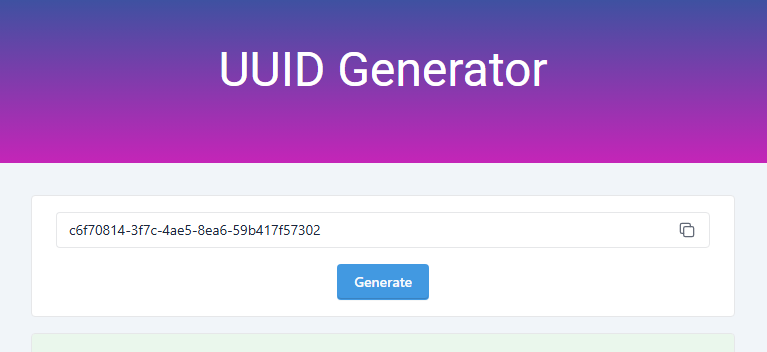
OKemall's UUID Generator provides a simple interface with an input field and a Generate action, making it convenient when you need a UUID quickly. (OKemall Website Tools)
Real-World Takeaway: A UUID is not just a random-looking string. It follows a defined structure and can be generated in different ways depending on the UUID version and the requirements of your application.
What Is a UUID?
A UUID (Universally Unique Identifier) is a 128-bit identifier standardized for identifying information in software systems.
A familiar UUID is commonly displayed in this format:
xxxxxxxx-xxxx-xxxx-xxxx-xxxxxxxxxxxxA UUID contains 32 hexadecimal characters separated by four hyphens.
A typical UUIDv4 might look like:
550e8400-e29b-41d4-a716-446655440000The exact value varies from UUID to UUID.
The current UUID specification is defined by RFC 9562, which describes UUID formats, versions, variants, generation methods, and implementation considerations. (RFC Editor)
UUIDs are particularly useful because different systems can generate identifiers independently without necessarily needing to coordinate a single sequential counter.
What Is a UUID Generator?
A UUID Generator is a tool that creates UUID values automatically.
Instead of manually creating an identifier, you can use a generator to produce a properly formatted UUID.
For example, a developer testing an API might need several unique-looking identifiers:
8f14e45f-ea4d-4c4b-a6e3-9b7e8f1a2c10
2c1743a3-91b2-47a8-bf54-8d5c71e4f932
7b52009b-6f3a-4d11-91c7-28e5f6a0b314
A UUID generator can save time when you need identifiers for testing, development, sample data, documentation, or application prototypes.
How to Use an Online UUID Generator
Using an online UUID Generator is straightforward.
Step 1: Open the UUID Generator
Open the UUID Generator tool on OKemall.
Step 2: Enter a value if the tool requires input
The current OKemall page provides an input area and a Generate control. (OKemall Website Tools)
Depending on the task, the input may be used according to the tool's available functionality.
Step 3: Generate the UUID
Click Generate to create the identifier.
Step 4: Copy the result
Copy the generated UUID and use it in your development environment, test data, documentation, or other appropriate project.
Real-World Takeaway: Generate UUIDs when you need identifiers, but always check your application's requirements before deciding which UUID version and generation method to use.
What Does a UUID Look Like?
A conventional UUID representation contains five groups of hexadecimal characters:
8-4-4-4-12For example:
123e4567-e89b-12d3-a456-426614174000The groups contain:
| Section | Hexadecimal characters |
|---|---|
| First group | 8 |
| Second group | 4 |
| Third group | 4 |
| Fourth group | 4 |
| Fifth group | 12 |
| Total | 32 |
The hyphens are formatting characters. The UUID itself represents 128 bits.
UUID versions and variants use specific bits within this structure to identify how the UUID was created and which layout rules apply. (RFC Editor)
Why Are UUIDs 128 Bits?
A UUID contains 128 bits.
That creates a very large number of possible values:
2¹²⁸
This is approximately:
3.4 × 10³⁸
The enormous size of the identifier space is one reason UUIDs are useful when systems need identifiers with an extremely low probability of accidental collision.
For UUID version 4, the specification describes 122 bits of random or pseudorandom data, with the remaining bits used for the version and variant information. (RFC Editor)
UUID Version 4 Explained
UUIDv4 is one of the most familiar UUID formats.
It is designed around randomly or pseudorandomly generated values. RFC 9562 specifies UUIDv4 as a randomly or pseudorandomly generated UUID and describes the placement of the version and variant bits. (RFC Editor)
A UUIDv4 follows a structure similar to:
xxxxxxxx-xxxx-4xxx-yxxx-xxxxxxxxxxxxThe 4 identifies the UUID version.
The character represented by y belongs to the UUID variant defined by the standard.
For example:
550e8400-e29b-41d4-a716-446655440000The third group begins with 4, indicating UUID version 4.
Why developers use UUIDv4
UUIDv4 is useful when an application needs identifiers generated from random or pseudorandom data rather than identifiers based on a timestamp or name.
Common applications include:
-
Database records
-
API resources
-
Test data
-
Distributed applications
-
Temporary identifiers
-
Object identifiers
-
File references
The appropriate choice depends on the application's requirements.
UUID Versions Explained
UUIDs are not limited to one generation method.
RFC 9562 defines several versions, each intended for different purposes. (RFC Editor)
| Version | General purpose |
|---|---|
| UUIDv1 | Time-based identifier |
| UUIDv3 | Name-based identifier using MD5 |
| UUIDv4 | Random or pseudorandom identifier |
| UUIDv5 | Name-based identifier using SHA-1 |
| UUIDv6 | Reordered time-based UUID |
| UUIDv7 | Unix-epoch-time-based UUID with random data |
| UUIDv8 | Custom application-defined format |
The choice should be based on the application's technical requirements rather than simply selecting the newest-looking number.
UUIDv1
UUID version 1 is a time-based UUID format.
Historically, it can incorporate timestamp and node-related information along with a clock sequence.
This can make UUIDv1 useful in systems where time-based generation is part of the design.
However, applications should consider the privacy and information-exposure implications of the generation method before using it.
UUIDv3
UUIDv3 is a name-based UUID.
It uses an MD5-based process with a namespace and name.
The same namespace and name can produce the same UUID, which makes name-based UUIDs fundamentally different from purely random UUID generation.
UUIDv4
UUIDv4 uses random or pseudorandom data.
It is one of the most common UUID formats developers encounter.
Its primary attraction is straightforward generation without requiring a meaningful name or timestamp relationship.
UUIDv5
UUIDv5 is another name-based UUID.
It uses SHA-1 with a namespace and name. RFC 9562 describes UUIDv5 as the name-based version using SHA-1. (RFC Editor)
UUIDv5 can be useful when the same input should deterministically produce the same UUID within a namespace.
UUIDv6
UUIDv6 is a reordered version of the time-based UUID approach.
The format was designed to make the timestamp portion more suitable for certain ordering and storage scenarios.
Applications that need time-related ordering should evaluate UUIDv6 and UUIDv7 against their specific database and application requirements.
UUIDv7
UUIDv7 uses a Unix epoch timestamp in milliseconds together with randomly generated data.
RFC 9562 recommends that implementations use UUIDv7 instead of UUIDv1 or UUIDv6 where possible. (RFC Editor)
This makes UUIDv7 particularly interesting for modern systems where time-based ordering can be useful while retaining a large random component.
A UUIDv7 is structurally different from UUIDv4 because part of its value represents time.
UUIDv8
UUIDv8 is intended for application-specific formats.
It provides space for custom UUID layouts within the constraints defined by the standard.
Developers should use custom formats only when there is a clear reason to do so.
UUID vs GUID: Are They the Same?
You may also encounter the term GUID, which means Globally Unique Identifier.
In many software environments, GUID and UUID are used to refer to identifiers with essentially the same general purpose and compatible textual representations.
The exact terminology can depend on the platform, framework, database, or documentation you are working with.
For everyday development discussions, you will often see both terms used.
UUID vs Auto-Increment ID
Traditional databases often use auto-incrementing integers:
1
2
3
4
5
UUIDs look very different:
c0a8e3f1-7b20-4b6c-a0d2-2c8f9e6a1234Neither approach is universally better. Each has different characteristics.
| Feature | Auto-Increment ID | UUID |
|---|---|---|
| Format | Integer | 128-bit identifier |
| Size | Usually smaller | Larger |
| Human readability | Easier | Harder |
| Distributed generation | Requires planning | Well suited |
| Sequential | Usually yes | Depends on UUID version |
| Collision probability | Managed by database | Extremely low when generated correctly |
| URL exposure | Easy to enumerate | Less naturally sequential |
| Database indexing | Often efficient | Requires appropriate design |
The right choice depends on your database architecture, indexing strategy, APIs, scale, and application requirements.
Why Developers Use UUIDs
UUIDs solve several practical problems.
1. Distributed ID generation
Multiple application servers can generate identifiers without maintaining one global counter.
This can be useful in distributed architectures.
2. Reduced dependence on sequential IDs
A UUID does not need to follow:
1001
1002
1003
1004
This can be useful when identifiers are created across independent systems.
3. Useful for APIs
An API resource can be identified with a UUID:
/users/550e8400-e29b-41d4-a716-446655440000This gives each resource a standardized identifier.
4. Database records
UUIDs can serve as primary keys or external identifiers, depending on the database design.
5. Test data
Developers frequently need unique identifiers while testing applications.
A UUID Generator makes creating test values faster.
Common Uses of UUIDs
UUIDs appear in many areas of software development.
Database records
A customer, product, order, invoice, or other record can have a UUID associated with it.
APIs
REST APIs and other services can use UUIDs to identify resources.
Microservices
Distributed applications often need identifiers that can be created independently by different services.
File systems and uploads
Applications can generate UUID-based names or references for uploaded objects.
Web applications
UUIDs can be used for users, sessions, objects, events, and other application resources.
Testing and development
Developers can generate sample identifiers without manually inventing values.
Event systems
Distributed systems can associate unique identifiers with individual events or messages.
UUIDs and Database Design
UUIDs can work well as database identifiers, but using them requires some thought.
A UUID is larger than a typical 32-bit or 64-bit integer. Depending on the database and indexing strategy, this can affect:
-
Storage requirements
-
Index size
-
Insert performance
-
Sorting behavior
-
Cache efficiency
-
Network payload size
For large systems, these details can matter.
Developers should choose the database representation carefully rather than assuming that storing UUIDs as plain text is always the best option.
UUID as a Database Primary Key
A UUID can be used as a primary key:
id
------------------------------------
550e8400-e29b-41d4-a716-446655440000
A second record could have:
7d444840-9dc0-11d1-b245-5ffdce74fad2This approach can be useful for distributed systems where identifiers need to be generated outside the database.
However, database design should consider indexing, storage format, UUID version, and expected workload.
UUIDs in URLs
Applications sometimes use UUIDs in URLs.
For example:
/products/550e8400-e29b-41d4-a716-446655440000Compared with:
/products/123the UUID is less naturally sequential.
That does not automatically make a resource secure.
A UUID should not be treated as a replacement for authentication or authorization.
If a resource is private, the application must still verify that the current user has permission to access it.
Real-World Takeaway: A difficult-to-guess identifier is not the same thing as access control. Security should come from proper authentication and authorization.
Are UUIDs Truly Unique?
The term "universally unique" describes the design goal and extremely large identifier space, not a mathematical guarantee that collisions are impossible.
For random UUIDs generated correctly, the probability of an accidental collision is extraordinarily small.
UUIDv4 provides 122 bits of random or pseudorandom data after accounting for the version and variant fields. (RFC Editor)
For ordinary software applications, this makes accidental collisions highly unlikely when a suitable random source and correct implementation are used.
That said, applications should still follow appropriate database constraints and error-handling practices.
UUID vs Random String
A random string and a UUID are not automatically the same thing.
A random string might look like:
x7Kp91LmQ2A UUID follows a defined standard structure:
550e8400-e29b-41d4-a716-446655440000The advantage of UUIDs is that software can recognize and process the format according to established specifications.
If your application specifically requires a UUID, generating an arbitrary random string is not an equivalent substitute.
How UUIDs Are Written
UUIDs are commonly represented using hexadecimal characters.
Hexadecimal uses:
0 1 2 3 4 5 6 7 8 9 A B C D E FA conventional textual UUID contains:
8-4-4-4-12For example:
6ba7b810-9dad-11d1-80b4-00c04fd430c8The exact meaning of particular fields depends on the UUID version.
UUID Generator for Developers
Developers may use an online UUID Generator when they need quick values for:
-
API testing
-
Database testing
-
JSON examples
-
Mock data
-
Documentation
-
Application prototypes
-
Development environments
-
Unit-test fixtures
-
Example URLs
-
Sample database records
Instead of manually creating a value and wondering whether its format is valid, a dedicated generator can provide a standardized UUID format.
UUID Generator for API Testing
Suppose you are testing an API endpoint that expects a user ID:
{
  "user_id": "550e8400-e29b-41d4-a716-446655440000"
}
A UUID Generator can provide values for repeated testing.
This is useful when testing:
-
GET requests
-
POST requests
-
PUT requests
-
DELETE requests
-
Database queries
-
Resource lookup
-
Validation rules
Using different identifiers during testing can also help developers reproduce edge cases.
UUID Generator for Sample Data
Documentation often needs realistic-looking identifiers.
Instead of repeatedly writing:
123
456
789
you can use UUID-formatted values.
This makes API documentation and development examples closer to what many real applications use.
UUID Formatting Mistakes to Avoid
Using an ordinary random string
If your application expects a UUID, use a UUID-compatible generator rather than an arbitrary string.
Removing required formatting without checking compatibility
Some systems accept UUIDs without hyphens, while others expect the conventional representation.
Always follow the format required by the application or API.
Treating UUIDs as passwords
A UUID is an identifier, not automatically a secret credential.
Do not use UUIDs as a substitute for passwords, authentication tokens, or authorization mechanisms.
Assuming every UUID is random
Different UUID versions use different generation methods.
UUIDv4 is random or pseudorandom, while UUIDv5 is name-based and UUIDv7 includes a timestamp component. (RFC Editor)
Choosing a UUID version without understanding the requirement
The UUID version can affect ordering, determinism, timestamp information, and other properties.
Select the format based on what your application actually needs.
UUID Generator vs UUID Library
An online UUID Generator and a programming library serve different purposes.
| Online UUID Generator | UUID Library |
|---|---|
| Convenient for quick values | Designed for application integration |
| Useful for testing | Suitable for production code |
| No coding required | Requires programming |
| Good for examples | Automates generation inside applications |
| Useful for developers and students | Best for repeatable application workflows |
If you need one or several UUIDs for testing, an online generator can be convenient.
If your production application needs to create UUIDs automatically, use a trusted UUID implementation appropriate for your programming language and environment.
UUID Generator in Different Programming Languages
Most modern programming languages provide libraries or built-in functionality for working with UUIDs.
For example, developers commonly encounter UUID support in ecosystems such as:
-
JavaScript
-
Python
-
PHP
-
Java
-
C#
-
Go
-
Ruby
-
Rust
The exact API differs between languages.
For production software, generating UUIDs inside the application is generally more appropriate than manually copying values from an online tool.
An online generator is particularly useful for development, testing, examples, and one-off requirements.
Is a UUID Generator Useful for SEO?
UUIDs themselves are not an SEO strategy.
A UUID is primarily an application identifier.
For example, this URL:
/example/550e8400-e29b-41d4-a716-446655440000does not automatically provide a search-engine advantage over a URL containing a normal ID.
For public web pages, descriptive URLs are usually more useful to people because they communicate what the page is about.
UUIDs make more sense when the URL represents a specific resource whose identifier is generated by an application.
Frequently Asked Questions About UUID Generators
What is a UUID Generator?
A UUID Generator is a tool that creates UUID values automatically. It is useful for development, testing, databases, APIs, sample data, and other software tasks.
What does UUID stand for?
UUID stands for Universally Unique Identifier.
How long is a UUID?
A UUID is 128 bits long and is commonly represented as 32 hexadecimal characters separated into five groups by hyphens.
What is UUIDv4?
UUIDv4 is a UUID version generated from random or pseudorandom data. RFC 9562 defines UUIDv4 and its bit layout. (RFC Editor)
Is UUIDv4 random?
UUIDv4 is designed around random or pseudorandom data. The specification reserves bits for the version and variant, leaving 122 bits for random or pseudorandom information. (RFC Editor)
What is UUIDv7?
UUIDv7 is a time-based UUID format using a Unix epoch timestamp in milliseconds together with random data. (RFC Editor)
Can a UUID be used as a database ID?
Yes. UUIDs can be used as database identifiers, including primary keys, depending on the database architecture and application requirements.
Are UUIDs secure?
A UUID is an identifier, not a complete security mechanism. Some UUID versions have properties that can expose information about how they were generated. Private resources still require proper authentication and authorization.
Can UUIDs collide?
A collision is theoretically possible, but correctly generated UUIDs are designed to make accidental collisions extremely unlikely. UUIDv4 has 122 random or pseudorandom bits under the standard layout. (RFC Editor)
What is the difference between UUID and GUID?
UUID and GUID are commonly used for the same general class of unique identifiers, although terminology varies between platforms and software ecosystems.
Which UUID version should I use?
There is no single version that is appropriate for every application. UUIDv4 is useful for random identifiers, while UUIDv5 can provide deterministic name-based identifiers and UUIDv7 can provide time-oriented identifiers. The correct choice depends on your application's requirements. (RFC Editor)
Can I use an online UUID Generator for production applications?
An online generator is useful for testing and sample data. For production systems that need identifiers automatically, it is generally better to generate UUIDs within your application using a reliable implementation.
UUID Quick Reference
| Term | Meaning |
|---|---|
| UUID | Universally Unique Identifier |
| Size | 128 bits |
| Common text format | 8-4-4-4-12 |
| UUIDv1 | Time-based |
| UUIDv3 | Name-based, MD5 |
| UUIDv4 | Random or pseudorandom |
| UUIDv5 | Name-based, SHA-1 |
| UUIDv6 | Reordered time-based |
| UUIDv7 | Unix epoch time + random data |
| UUIDv8 | Custom application-specific format |
Use the OKemall UUID Generator
When you need a UUID for testing, development, documentation, sample data, or a quick technical task, an online generator can save you from creating identifiers manually.
The OKemall UUID Generator provides a simple interface centered on generating UUID values, making it suitable for quick developer and testing workflows. (OKemall Website Tools)
For production applications, UUID generation should normally be handled by your application's own trusted UUID implementation. For one-off values, development examples, API testing, and sample data, an online UUID Generator is a practical option.
Understanding the UUID format is just as important as generating one. Once you know the difference between UUID versions, random and name-based identifiers, and time-oriented formats, you can choose identifiers based on the actual needs of your software rather than simply selecting a value that looks unique.

Popular Tools
Recent Posts