Digital Converter: Convert Bits, Bytes, MB, GB & More
Convert Bits, Bytes, Kilobits, Megabits and More Online
Digital storage and data transfer measurements can become confusing quickly.
A file might be measured in bytes. An internet connection may be advertised in megabits per second. Storage devices commonly use gigabytes or terabytes. Networking documentation can refer to bits, kilobits, megabits, or gigabits.
The numbers may look similar.
The units aren't.
A Digital Converter helps translate digital information between different units so you can understand how much data a value actually represents.
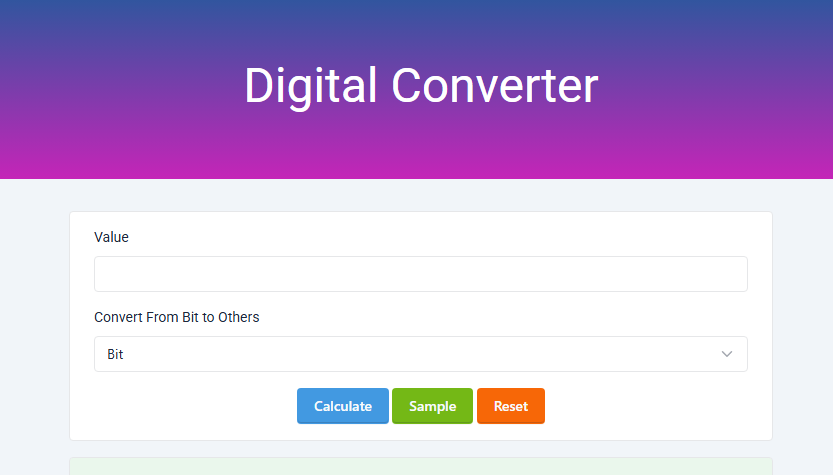
The OKemall Digital Converter provides an online conversion interface where you can enter a value, select the source unit, choose the unit you want to convert to, and calculate the result. The current tool starts with Bit as the default source unit and is designed for digital-unit conversions. (OKemall Website Tools)
This guide explains digital data units, the difference between bits and bytes, decimal and binary measurements, common conversion formulas, practical examples, and how to use a digital converter accurately.
Real-World Takeaway: The most common digital-unit mistake is confusing bits (b) with bytes (B). A lowercase
bgenerally represents a bit, while an uppercaseBrepresents a byte. One byte contains eight bits.
What Is a Digital Converter?
A Digital Converter is an online unit conversion tool for calculating equivalent values between digital information units.
For example, you may want to convert:
-
Bits to bytes
-
Bytes to bits
-
Kilobits to bits
-
Megabits to bits
-
Gigabits to bits
-
Bytes to kilobytes
-
Megabytes to gigabytes
-
Gigabytes to terabytes
The exact conversion depends on the units and convention being used.
The basic relationship is:
1 byte = 8 bits
So:
8 bits = 1 byte
16 bits = 2 bytes
80 bits = 10 bytes
800 bits = 100 bytes
That simple relationship is the foundation of many digital-data conversions.
How to Use a Digital Converter
Using an online digital converter is straightforward.
The OKemall Digital Converter provides a value field, a source-unit selector, and a calculation function. (OKemall Website Tools)
Step 1: Enter the value
Enter the digital quantity you want to convert.
For example:
1000Step 2: Select the original unit
Choose the unit that describes your starting value.
For example:
BitStep 3: Select the target unit
Choose the unit you want to calculate.
For example:
ByteStep 4: Calculate
Run the conversion.
The converter performs the required mathematical operation and provides the corresponding value.
Step 5: Check the unit
Always read the output together with its unit.
8000 bits and 8000 bytes represent very different quantities.
The number alone isn't enough.
What Is a Bit?
A bit is the smallest basic unit of digital information.
The word comes from binary digit.
A bit can represent one of two binary states, commonly written as:
0or:
1Computer systems use combinations of bits to represent data.
For example:
1 bit
8 bits
16 bits
32 bits
64 bits
As more bits are combined, they can represent increasingly large sets of possible values.
Bits are especially common when discussing data transmission speeds.
For example:
-
Mbps = megabits per second
-
Gbps = gigabits per second
-
Kbps = kilobits per second
This is why internet connection speeds are frequently advertised using bits rather than bytes.
What Is a Byte?
A byte consists of eight bits.
The fundamental relationship is:
1 byte = 8 bits
Therefore:
8 bits = 1 byteAnd:
80 bits = 10 bytesBytes are widely used to describe the size of files, applications, documents, images, videos, and digital storage.
Common byte-based units include:
-
B — byte
-
KB — kilobyte
-
MB — megabyte
-
GB — gigabyte
-
TB — terabyte
-
PB — petabyte
When you see a file described as 25 MB, the B refers to bytes.
When an internet connection is described as 100 Mbps, the b refers to bits.
That capitalization matters.
Bits vs. Bytes
This is the most important distinction to understand before using a digital converter.
| Unit | Symbol | Relationship |
|---|---|---|
| Bit | b | Basic binary unit |
| Byte | B | 8 bits |
| Kilobit | kb | 1,000 bits in decimal notation |
| Kilobyte | kB | 1,000 bytes in decimal notation |
| Megabit | Mb | 1,000,000 bits in decimal notation |
| Megabyte | MB | 1,000,000 bytes in decimal notation |
| Gigabit | Gb | 1,000,000,000 bits in decimal notation |
| Gigabyte | GB | 1,000,000,000 bytes in decimal notation |
Notice the capitalization:
Mb ≠ MB
A megabit is not a megabyte.
A megabit is eight times smaller than a megabyte when both are expressed using the same decimal prefix.
How to Convert Bits to Bytes
The formula is simple:
Bytes = Bits ÷ 8
For example:
800 bits ÷ 8 = 100 bytesTherefore:
800 bits = 100 bytes
Another example:
8,000 bits ÷ 8 = 1,000 bytesSo:
8,000 bits = 1,000 bytes
The reverse calculation is equally simple.
How to Convert Bytes to Bits
Use:
Bits = Bytes × 8
For example:
100 bytes × 8 = 800 bitsTherefore:
100 bytes = 800 bits
For a larger value:
1,000 bytes × 8 = 8,000 bitsSo:
1,000 bytes = 8,000 bits
Decimal vs. Binary Digital Units
Digital storage becomes more complicated when larger units are involved because decimal and binary measurement systems are both used.
Decimal system
Decimal prefixes are based on powers of 1,000.
For example:
1 KB = 1,000 bytes
1 MB = 1,000 KB
1 GB = 1,000 MB
1 TB = 1,000 GB
This system is commonly associated with SI prefixes.
Binary system
Binary prefixes are based on powers of 1,024.
The corresponding standardized names include:
-
KiB — kibibyte
-
MiB — mebibyte
-
GiB — gibibyte
-
TiB — tebibyte
For example:
1 KiB = 1,024 bytes
and:
1 MiB = 1,024 KiB
These aren't merely different spellings.
They're different measurement systems.
KB vs. KiB: What's the Difference?
The distinction is easy to overlook.
KB normally refers to a kilobyte using the decimal convention:
1 KB = 1,000 bytes
KiB refers to a kibibyte using the binary convention:
1 KiB = 1,024 bytes
The same distinction applies to larger units:
| Decimal | Binary |
|---|---|
| KB | KiB |
| MB | MiB |
| GB | GiB |
| TB | TiB |
| PB | PiB |
When comparing storage specifications, operating-system displays, software documentation, or technical benchmarks, check which convention is being used.
Digital Conversion Examples
Convert 8 Bits to Bytes
8 bits ÷ 8 = 1 byteAnswer: 1 byte
Convert 64 Bits to Bytes
64 bits ÷ 8 = 8 bytesAnswer: 8 bytes
Convert 1,000 Bits to Bytes
1,000 bits ÷ 8 = 125 bytesAnswer: 125 bytes
Convert 10,000 Bits to Bytes
10,000 bits ÷ 8 = 1,250 bytesAnswer: 1,250 bytes
Why Internet Speed Uses Bits
Internet service providers commonly describe connection speeds in bits per second.
Examples include:
-
Kbps — kilobits per second
-
Mbps — megabits per second
-
Gbps — gigabits per second
Suppose an internet connection is advertised at:
100 Mbps
That represents 100 megabits per second.
To express the same rate in megabytes per second using the simple 8-bit-to-1-byte relationship:
100 Mbps ÷ 8 = 12.5 MB/sSo 100 megabits per second corresponds mathematically to 12.5 megabytes per second under the same prefix convention.
Actual download speeds can be lower because network performance is affected by protocol overhead, server performance, congestion, Wi-Fi conditions, and other factors.
Real-World Takeaway: Don't compare
100 Mbpsdirectly with100 MB/s. The capitalBchanges the unit by a factor of eight.
Digital Storage vs. Internet Speed
A common source of confusion is that storage and network speed often use different-looking units.
| Measurement | Common unit |
|---|---|
| File size | Bytes |
| Photo size | MB |
| Video file | GB |
| SSD capacity | GB or TB |
| Internet speed | Mbps or Gbps |
| Network throughput | Mbps or Gbps |
| Memory capacity | GB |
| Data transfer | Bits or bytes per second |
For example:
A video file could be 2 GB.
An internet connection could be 200 Mbps.
Those numbers aren't directly comparable until their units are converted.
How Long Does It Take to Download a File?
Digital conversion can help estimate download times.
Suppose you have a 1 GB file and a connection capable of 100 Mbps under idealized conditions.
First convert the file size into bits.
Using decimal units:
1 GB = 1,000,000,000 bytesThen:
1,000,000,000 bytes × 8
= 8,000,000,000 bits
At 100,000,000 bits per second:
8,000,000,000 ÷ 100,000,000
= 80 seconds
So the theoretical transfer time is approximately 80 seconds.
Real-world downloads may take longer.
Network conditions matter.
Why Real Download Speeds Differ
A digital converter can give you the mathematical relationship between units.
It can't predict the exact performance of a network.
Actual transfer speeds can be affected by:
-
Network congestion
-
Wi-Fi signal quality
-
Router performance
-
Server capacity
-
Distance from the server
-
Protocol overhead
-
Device performance
-
Background traffic
-
ISP network conditions
For that reason, a theoretical calculation should be treated as an estimate rather than a guarantee.
Common Digital Units
Understanding the most common units makes digital conversion much easier.
Bit
Symbol:
b
A basic unit of digital information.
Byte
Symbol:
B
One byte equals eight bits.
Kilobit
Symbol:
kb
Often used when discussing network speeds.
Megabit
Symbol:
Mb
Commonly used for internet speeds.
Gigabit
Symbol:
Gb
Often used for high-speed network connections.
Kilobyte
Symbol:
kB
Used for relatively small amounts of byte-based data.
Megabyte
Symbol:
MB
Common for images, documents, audio files, and software components.
Gigabyte
Symbol:
GB
Common for applications, videos, storage devices, and memory.
Terabyte
Symbol:
TB
Common for large storage devices and data collections.
Digital Converter Quick Reference
| Conversion | Formula |
|---|---|
| Bits → Bytes | Bits ÷ 8 |
| Bytes → Bits | Bytes × 8 |
| Kilobits → Bits | Kilobits × 1,000 |
| Megabits → Bits | Megabits × 1,000,000 |
| Gigabits → Bits | Gigabits × 1,000,000,000 |
| Kilobytes → Bytes | Kilobytes × 1,000 |
| Megabytes → Bytes | Megabytes × 1,000,000 |
| Gigabytes → Bytes | Gigabytes × 1,000,000,000 |
These formulas use decimal prefixes.
When a binary unit such as KiB, MiB, or GiB is specified, use powers of 1,024 instead.
Digital Converter for Developers
Developers frequently encounter digital units in applications, APIs, databases, network monitoring, and file-processing systems.
A program may report:
byteswhile a monitoring dashboard displays:
MB/sor:
MbpsConverting between these measurements prevents incorrect interpretations.
For example, if an API reports:
1048576 bytesthat value is:
1 MiB
because:
1 MiB = 1,048,576 bytesThis is a good example of why decimal and binary prefixes shouldn't be mixed casually.
Digital Converter for File Sizes
File sizes are usually expressed in bytes and larger byte-based units.
For example:
Document: 2 MB
Image: 5 MB
Video: 1.5 GB
Backup: 500 GB
Storage drive: 2 TB
If you need to compare a file size with a network transfer rate, convert both into compatible units first.
For example:
File size → bytes or bits
Network speed → bytes/second or bits/second
Only then should you calculate the estimated transfer time.
Digital Converter for Network Speeds
Network administrators, developers, and technology enthusiasts often need to convert between:
-
Kbps
-
Mbps
-
Gbps
-
KB/s
-
MB/s
-
GB/s
The fundamental relationship remains:
8 bits = 1 byte
So:
80 Mbps ÷ 8 = 10 MB/sAgain, this is a mathematical conversion.
Actual throughput can differ.
Common Digital Conversion Mistakes
Mistake 1: Confusing b and B
This is the biggest one.
Mb = megabit
MB = megabyte
They aren't interchangeable.
Mistake 2: Assuming every kilo means 1,024
In decimal SI usage, kilo means 1,000.
Binary computing units use 1,024 and standardized prefixes such as KiB.
Mistake 3: Comparing storage with network speed directly
A 1 GB file and a 1 Gbps connection use different units.
Convert them first.
Mistake 4: Ignoring the time component
MB and MB/s aren't the same.
The /s means per second.
Mistake 5: Treating theoretical transfer speed as actual speed
Real networks have overhead and performance limitations.
Mistake 6: Rounding too early
For technical calculations, premature rounding can create noticeable differences in larger conversions.
Digital Units and Their Symbols
Capitalization matters.
| Symbol | Meaning |
|---|---|
| b | bit |
| B | byte |
| kb | kilobit |
| kB | kilobyte |
| Mb | megabit |
| MB | megabyte |
| Gb | gigabit |
| GB | gigabyte |
| Tb | terabit |
| TB | terabyte |
Compare:
1 MB = 8 Mb
when both use the same decimal prefix.
The difference is the bit-versus-byte relationship.
When Should You Use a Digital Converter?
A digital converter is useful whenever you need to translate a digital measurement into another unit.
Common situations include:
-
Checking internet speed
-
Comparing download rates
-
Understanding file sizes
-
Estimating download time
-
Working with storage specifications
-
Reading technical documentation
-
Developing software
-
Monitoring network performance
-
Comparing data-transfer measurements
-
Learning digital-unit relationships
For occasional calculations, an online converter is faster than repeatedly searching for conversion formulas.
Why Use an Online Digital Converter?
Manual conversion is possible.
But repetitive calculations become tedious.
An online tool provides a faster workflow:
Enter → Select → Calculate → Check
The OKemall Digital Converter is built around this process. Its current page provides a value input, a source-unit selector beginning with Bit, and a calculation function for digital-unit conversions. (OKemall Website Tools)
That makes it useful when you need a quick conversion without building the formula yourself.
Digital Converter vs. Manual Calculation
| Method | Best for | Main advantage |
|---|---|---|
| Online Digital Converter | Quick conversions | Fast and convenient |
| Calculator | Simple known formulas | No website required |
| Spreadsheet | Repeated calculations | Easy to process many values |
| Code | Automated systems | Scalable and repeatable |
| Manual formula | Learning | Helps understand the mathematics |
The best method depends on the task.
One conversion doesn't require a complex program.
Thousands of conversions might.
Frequently Asked Questions
What is a Digital Converter?
A Digital Converter is a tool used to convert digital information between units such as bits, bytes, kilobits, megabits, and larger data measurements.
How many bits are in one byte?
There are 8 bits in 1 byte.
How do I convert bits to bytes?
Divide the number of bits by 8.
Bytes = Bits ÷ 8
How do I convert bytes to bits?
Multiply the number of bytes by 8.
Bits = Bytes × 8
What is the difference between Mb and MB?
Mb means megabit, while MB means megabyte. Since one byte contains eight bits, their values differ by a factor of eight when using the same prefix convention.
Is 1 KB equal to 1,024 bytes?
Not always. Under the decimal convention, 1 KB = 1,000 bytes. The binary unit 1 KiB = 1,024 bytes.
What is Mbps?
Mbps means megabits per second and is commonly used to describe network or internet connection speeds.
What is MB/s?
MB/s means megabytes per second and describes a rate of transferring bytes over time.
How do I convert Mbps to MB/s?
For a straightforward bit-to-byte conversion using the same prefix convention, divide Mbps by 8.
For example:
80 Mbps ÷ 8 = 10 MB/s
Can a digital converter calculate download time?
A digital unit converter can help provide the values needed for a download-time estimate, but actual download performance depends on network and server conditions.
What is the difference between GB and GiB?
GB is a decimal unit, while GiB is a binary unit.
1 GB = 1,000,000,000 bytes
1 GiB = 1,073,741,824 bytes
Who needs a Digital Converter?
Students, developers, network administrators, IT professionals, technology enthusiasts, content creators, and everyday computer users can all benefit from digital-unit conversion.
Calculate Digital Units Online
Digital measurements become much easier once the units are understood.
Remember the most important relationship:
1 byte = 8 bits
Then pay attention to the prefixes.
KB isn't necessarily the same as KiB.
MB isn't the same as Mb.
GB isn't the same as Gb.
Those small differences in capitalization and notation can completely change the quantity being represented.
For quick conversions, use the OKemall Digital Converter. Enter your value, select the original digital unit, choose the target unit, and calculate the result. (OKemall Website Tools)

Popular Tools
Recent Posts