MD5 Generator: Generate MD5 Hash Online Free
Generate MD5 Hashes Online and Understand How MD5 Works
When developers need to turn text or other data into a fixed-length hash, MD5 is one of the algorithm names they are likely to encounter.
An MD5 Generator takes input and produces an MD5 hash, commonly displayed as a 32-character hexadecimal string. The process is fast, deterministic, and easy to reproduce, which is why MD5 still appears in legacy software, checksums, development tools, file-identification workflows, and technical documentation.
But there is an important distinction that should not be overlooked: MD5 is no longer considered suitable for security-sensitive cryptographic applications. Modern applications that need a secure cryptographic hash should use a current algorithm designed for that purpose rather than relying on MD5. NIST's published guidance describes modern approved hash functions such as SHA-256 and SHA-3, while RFC 6151 documents security concerns with MD5. (NIST Computer Security Resource Center)
That does not make MD5 useless. It means developers need to understand what MD5 does well, where it is still encountered, and where another algorithm is the appropriate choice.
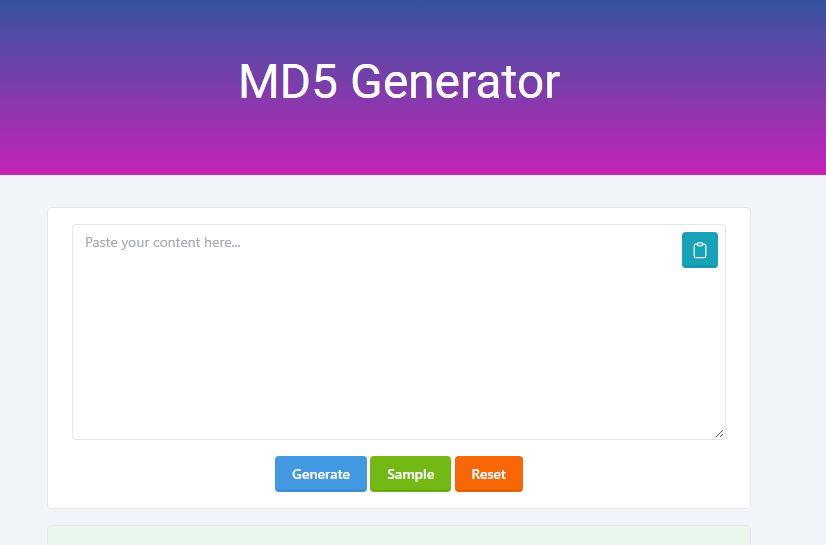
The OKemall MD5 Generator provides a simple interface with Generate, Sample, and Reset controls for working with MD5 hashes online. (OKemall Website Tools)
Real-World Takeaway: MD5 is useful for understanding and working with existing MD5 data, but it should not be treated as a modern password-hashing or security solution.
What Is an MD5 Generator?
An MD5 Generator is an online tool that calculates the MD5 hash of an input value.
You provide input data, and the generator applies the MD5 algorithm to produce a fixed-length digest.
For example, the classic MD5 test vector for the text abc is:
900150983cd24fb0d6963f7d28e17f72This result is not a shortened version of the original text. It is a 128-bit message digest represented as 32 hexadecimal characters. RFC 1321, the original MD5 specification, defines MD5 as an algorithm that accepts a message of arbitrary length and produces a 128-bit message digest. (RFC Editor)
The same input produces the same MD5 result when processed correctly.
Change even a small part of the input, however, and the resulting hash will normally change substantially.
What Does MD5 Stand For?
MD5 stands for Message-Digest Algorithm 5.
The algorithm was designed by Ronald Rivest and published as RFC 1321 in 1992. The original specification describes MD5 as a message-digest algorithm that produces a 128-bit fingerprint of its input. (RFC Editor)
MD5 was originally developed for cryptographic applications, including digital signature-related uses. Its security assumptions have since been undermined by cryptanalytic advances.
That historical context matters when reading older software documentation or working with legacy systems.
What Is an MD5 Hash?
An MD5 hash is the output produced by the MD5 algorithm.
It is usually represented using hexadecimal characters.
A typical MD5 hash looks like this:
5d41402abc4b2a76b9719d911017c592It contains:
-
32 hexadecimal characters
-
128 bits of output
-
A fixed-length representation
-
No spaces in the conventional hexadecimal form
The length of the original input does not determine the length of the hexadecimal MD5 output.
A short string and a large file can both produce a 32-character hexadecimal MD5 digest.
How Does an MD5 Generator Work?
The basic process is straightforward.
1. Enter the input
You provide text or data to be hashed.
For example:
Hello World2. The MD5 algorithm processes the input
The algorithm processes the message according to the MD5 specification.
3. A 128-bit digest is produced
The algorithm generates a fixed-size message digest.
4. The digest is displayed in hexadecimal
The binary digest is commonly represented using 32 hexadecimal characters.
The result can then be copied and compared with another MD5 value.
The important point is that MD5 is a hash function, not an encryption algorithm. The original input is not simply transformed into something that can be decrypted with a key.
How to Use the OKemall MD5 Generator
The OKemall MD5 Generator is designed for quick online MD5 generation. Its current page provides Generate, Sample, and Reset controls. (OKemall Website Tools)
Step 1: Open the MD5 Generator
Open the OKemall MD5 Generator page.
Step 2: Enter your input
Enter the text or value that you want to process.
For example:
HelloStep 3: Generate the hash
Use the Generate option to calculate the MD5 digest.
Step 4: Copy the result
Once the hash is generated, copy it for your development, testing, comparison, or documentation task.
Step 5: Reset for another calculation
Use the Reset option when you want to start again with different input.
Real-World Takeaway: When comparing MD5 hashes, make sure the input is exactly the same. Differences in capitalization, spaces, punctuation, line breaks, or encoding can produce a different digest.
Example of an MD5 Hash
Consider the input:
abcThe corresponding MD5 test vector is:
900150983cd24fb0d6963f7d28e17f72This is one of the standard examples included in the original MD5 specification. (RFC Editor)
If you change the input to:
abcdyou should not expect the same hash.
That deterministic behavior is one of the defining characteristics of a hash function.
MD5 Hash Properties
MD5 has several characteristics that explain why it was historically useful.
Fixed output size
MD5 produces a 128-bit digest regardless of the input length. (RFC Editor)
Deterministic
The same input produces the same output when processed using the same algorithm and encoding.
Fast
MD5 was designed to be computationally efficient, particularly on the hardware of its era. (RFC Editor)
One-way design
Hash functions are designed differently from ordinary reversible encryption. You generally do not "decrypt" an MD5 hash to recover the original input.
Collision weakness
This is where modern security considerations become important.
MD5 is no longer considered collision-resistant for security-sensitive applications. NIST's materials explain collision resistance as the difficulty of finding two different inputs that produce the same hash, and MD5 has known weaknesses in this area. (NIST Computer Security Resource Center)
Is MD5 Encryption?
No.
MD5 is hashing, not encryption.
Encryption is designed so that authorized parties can recover the original information using an appropriate key.
Hashing produces a digest of the input.
A simplified comparison:
| Feature | Hashing | Encryption |
|---|---|---|
| Main purpose | Create a digest | Protect information |
| Normally reversible | No | Yes, with the correct key |
| Uses a key | Not necessarily | Typically |
| Output | Fixed-size for many hash algorithms | Depends on algorithm |
| Example | MD5, SHA-256 | AES |
| Typical use | Integrity, identifiers, fingerprints | Confidentiality |
Calling MD5 "encryption" can create confusion when discussing application security.
Is MD5 Secure?
For modern security-sensitive cryptographic applications, MD5 should not be considered secure.
The original MD5 design dates from 1992. Since then, researchers have demonstrated practical weaknesses, particularly involving collisions. NIST has documented that MD5 and SHA-1 have been successfully attacked and are not advisable for some applications. (NIST)
This is why modern systems generally use stronger hash algorithms when cryptographic security is required.
Examples include:
-
SHA-256
-
SHA-384
-
SHA-512
-
SHA-3 family algorithms
NIST's current hash-function guidance lists modern approved hash functions and their security properties. (NIST Computer Security Resource Center)
Why Should You Still Use an MD5 Generator?
The security limitations of MD5 do not mean that there is no reason to calculate an MD5 hash.
There are many legitimate technical situations where you may need to read, reproduce, compare, or validate an existing MD5 value.
Legacy software
Older applications may still store or reference MD5 hashes.
File verification
Some older systems publish MD5 checksums alongside downloadable files.
If a trusted source provides an MD5 checksum, calculating the MD5 value of the downloaded file can help you compare the values.
However, MD5's collision weaknesses mean it should not be treated as a strong security guarantee against a maliciously modified file.
Development and testing
Developers may need known MD5 values while testing an application.
API and integration testing
Legacy APIs may expect MD5 values as part of their existing protocol.
Database migration
When maintaining older systems, developers may encounter databases containing MD5 values.
Technical research
Students and developers often use MD5 to understand how hash functions work and why cryptographic standards evolve.
MD5 for File Checksums
One of the most recognizable uses of MD5 is file checksum generation.
Suppose a software publisher provides:
example.zip
MD5: 098f6bcd4621d373cade4e832627b4f6
A user can calculate the MD5 of the local file and compare the result.
If the values match, the files have the same MD5 digest.
If they differ, something about the file or the hashing process is different.
However, a matching MD5 value should not be interpreted as proof that a file is trustworthy against an attacker. MD5's collision weaknesses make it inappropriate as a modern security mechanism for adversarial integrity protection.
For security-sensitive file verification, stronger cryptographic hashes such as SHA-256 are generally preferable.
MD5 for Passwords: An Important Warning
You may still find old tutorials recommending MD5 for password storage.
That is outdated advice.
Do not use plain MD5 to store passwords in a modern application.
Password storage requires a password-hashing scheme specifically designed to resist guessing attacks. General-purpose hash functions such as MD5 are far too fast for this purpose.
Modern password-storage systems should use dedicated password hashing mechanisms such as:
-
Argon2
-
bcrypt
-
scrypt
-
PBKDF2
The choice depends on the programming language, framework, threat model, and current security guidance.
A simple MD5 hash does not provide the protections expected from a modern password-storage design.
Security Note: Never assume that a hash is suitable for password storage simply because it is difficult to read. Password hashing has different requirements from ordinary checksums or general-purpose message digests.
MD5 vs SHA-256
MD5 and SHA-256 are both hash algorithms, but they are not equivalent from a modern security perspective.
| Feature | MD5 | SHA-256 |
|---|---|---|
| Output size | 128 bits | 256 bits |
| Common representation | 32 hex characters | 64 hex characters |
| Historical use | Checksums, legacy systems, cryptographic applications | Modern cryptographic applications |
| Collision resistance | Broken for security use | Much stronger |
| Suitable for modern security? | No for security-sensitive use | Commonly used |
| Legacy compatibility | High | Depends on system |
NIST's published hash-function information identifies SHA-256 as having a 256-bit output and provides substantially stronger security-strength figures than older algorithms such as MD5. (NIST Computer Security Resource Center)
MD5 vs SHA-1
MD5 and SHA-1 are both older hash algorithms with known security weaknesses.
They were designed at different times and have different output sizes:
-
MD5: 128 bits
-
SHA-1: 160 bits
Neither should be selected for a new security-sensitive application simply because it is familiar.
Modern applications should use a current cryptographic hash algorithm appropriate to the specific task.
MD5 vs SHA-256: Which One Should You Use?
The answer depends on why you are hashing something.
If you are working with an existing system that specifically requires MD5, you may need MD5 for compatibility.
If you are designing a new security-sensitive system, MD5 is generally not the appropriate choice.
For modern cryptographic hashing, SHA-256 or an appropriate SHA-3-family algorithm may be a better fit, depending on the application and requirements. NIST's current hash-function guidance lists these modern algorithms and their security properties. (NIST Computer Security Resource Center)
MD5 and Collision Attacks
A collision occurs when two different inputs produce the same hash value.
In the ideal behavior of a collision-resistant cryptographic hash function, deliberately finding such a pair should be computationally impractical.
MD5 does not meet that standard today.
This is one of the main reasons MD5 should not be used for applications where collision resistance is a security requirement. NIST has specifically discussed the successful cryptanalytic attacks against MD5 and the resulting limitations for certain applications. (NIST)
This distinction is important:
MD5 can still calculate a hash correctly.
But:
Correct calculation does not mean modern cryptographic security.
Is an MD5 Hash Reversible?
MD5 is not designed as a reversible encryption system.
There is no normal "decrypt MD5" operation that simply turns:
900150983cd24fb0d6963f7d28e17f72back into:
abcHowever, weak or predictable inputs may be discoverable through guessing, precomputed data, or other techniques. That is another reason MD5 should not be used to protect passwords or other sensitive secrets.
Why Does the Same Input Always Produce the Same MD5?
MD5 is deterministic.
If you hash exactly the same sequence of input bytes using MD5, you get the same digest.
For example:
Input:
abc

MD5:
900150983cd24fb0d6963f7d28e17f72
Run the same calculation again and the result remains the same.
This makes hashes useful for comparison and verification workflows.
Why Does a Small Input Change Produce a Different Hash?
Cryptographic hash functions are designed to produce a significant change in the output when the input changes.
For example:
abcand:
abdare almost identical as text, but their MD5 hashes will be different.
This behavior is often called the avalanche effect.
It helps make hashes useful as compact fingerprints of data.
Common MD5 Generator Use Cases
An online MD5 Generator can be useful for:
Developers
Generate test values while developing applications.
Students
Experiment with hash functions and understand deterministic hashing.
QA testers
Create known hash values for testing validation logic.
Legacy system administrators
Work with systems that still use MD5.
File verification workflows
Reproduce an MD5 checksum provided by an existing system.
Documentation writers
Create sample MD5 values for technical documentation.
Data comparison
Compare MD5 values generated from identical data.
Common Mistakes When Using an MD5 Generator
Mistake 1: Treating MD5 as encryption
MD5 is a hash function, not encryption.
Mistake 2: Using MD5 for passwords
Plain MD5 is not an appropriate modern password-storage mechanism.
Mistake 3: Assuming a matching hash proves authenticity
A matching MD5 value can show that two inputs produce the same digest. It does not automatically establish who created the file or whether an attacker could have manipulated the data.
Mistake 4: Ignoring whitespace
These inputs are different:
Helloand:
Hello The second contains an additional space.
Mistake 5: Ignoring capitalization
These are different inputs:
Hello
hello
Their hashes will differ.
Mistake 6: Using MD5 for a new cryptographic design
If you are building a new security-sensitive application, evaluate current cryptographic standards rather than selecting MD5 because it is easy to implement.
MD5 Hash Format
A conventional MD5 digest is represented as 32 hexadecimal characters.
For example:
d41d8cd98f00b204e9800998ecf8427eThis is the MD5 digest of an empty input.
The hexadecimal characters represent the underlying 128-bit result.
| Property | MD5 |
|---|---|
| Full name | Message-Digest Algorithm 5 |
| Output | 128 bits |
| Common hexadecimal length | 32 characters |
| Input size | Variable |
| Output size | Fixed |
| Deterministic | Yes |
| Modern collision resistance | No |
| Appropriate for passwords | No |
| Useful for legacy compatibility | Yes |
Frequently Asked Questions About MD5 Generators
What is an MD5 Generator?
An MD5 Generator is a tool that calculates an MD5 hash from input data and displays the resulting 128-bit digest, commonly as a 32-character hexadecimal string.
What is MD5 used for?
MD5 is still encountered in legacy software, existing checksums, development, testing, and compatibility workflows. It should not be selected for new security-sensitive cryptographic applications.
Is MD5 secure?
MD5 is not considered secure for modern collision-resistant cryptographic applications. Known attacks against MD5 are the reason modern systems generally use stronger hash functions. (NIST)
Is MD5 encryption?
No. MD5 is a hash function, not an encryption algorithm.
Can MD5 be decrypted?
There is no standard decryption operation for MD5. It produces a digest rather than encrypted data.
How long is an MD5 hash?
An MD5 digest is 128 bits, normally represented as 32 hexadecimal characters. (RFC Editor)
Can MD5 be used for passwords?
Plain MD5 should not be used for modern password storage. Dedicated password-hashing algorithms are designed for this purpose.
What should I use instead of MD5?
For modern cryptographic hashing, algorithms such as SHA-256 and SHA-3 may be appropriate depending on the application. For password storage, use a dedicated password-hashing scheme rather than a general-purpose hash.
Can MD5 detect file changes?
An MD5 comparison can detect many accidental changes because a changed input normally produces a different digest. However, MD5 should not be relied upon as a strong security mechanism against intentional manipulation because of its collision weaknesses.
Does the same input always produce the same MD5 hash?
Yes. MD5 is deterministic, so the same input bytes produce the same digest when processed correctly.
Why are MD5 hashes 32 characters long?
The MD5 output is 128 bits. Representing those 128 bits in hexadecimal requires 32 hexadecimal characters.
Is an online MD5 Generator useful for developers?
Yes. It can be convenient for testing, development, legacy compatibility, checksum comparison, documentation, and learning about hashing.
MD5 Quick Reference
| Item | Information |
|---|---|
| Algorithm | MD5 |
| Full name | Message-Digest Algorithm 5 |
| Standard specification | RFC 1321 |
| Output size | 128 bits |
| Hexadecimal representation | 32 characters |
| Input size | Arbitrary |
| Same input → same hash | Yes |
| Encryption | No |
| Modern password storage | Not recommended |
| Modern collision-sensitive security | Not recommended |
| Legacy compatibility | Common use case |
| Modern alternatives | SHA-256, SHA-3 and other appropriate algorithms |
Generate an MD5 Hash Online
If you need to calculate an MD5 value for development, testing, learning, documentation, or compatibility with an existing system, an online MD5 Generator can make the process quick and straightforward.
The OKemall MD5 Generator provides a simple interface with Generate, Sample, and Reset controls, allowing users to work with MD5 values without installing a separate application. (OKemall Website Tools)
For modern security architecture, however, the algorithm should be chosen based on the actual security requirement. MD5 remains useful when you need to work with an existing MD5-based system, but its historical security weaknesses make it unsuitable for many new cryptographic applications. (NIST Computer Security Resource Center)
Understanding that difference is the key to using an MD5 Generator responsibly: use MD5 where compatibility or non-security-sensitive hashing calls for it, and choose modern cryptographic or password-hashing algorithms when genuine security is required.

Popular Tools
Recent Posts