Sales Tax Calculator: Calculate Sales Tax & Final Price Online
Calculate Sales Tax and Final Price Online
A Sales Tax Calculator makes it easy to calculate sales tax, determine the tax-inclusive price, and find the amount you’ll pay after tax.
Whether you're checking the cost of an online purchase, preparing an invoice, reviewing a receipt, comparing prices, or learning how percentage-based taxes work, a sales tax calculator can save time and reduce manual calculation errors.
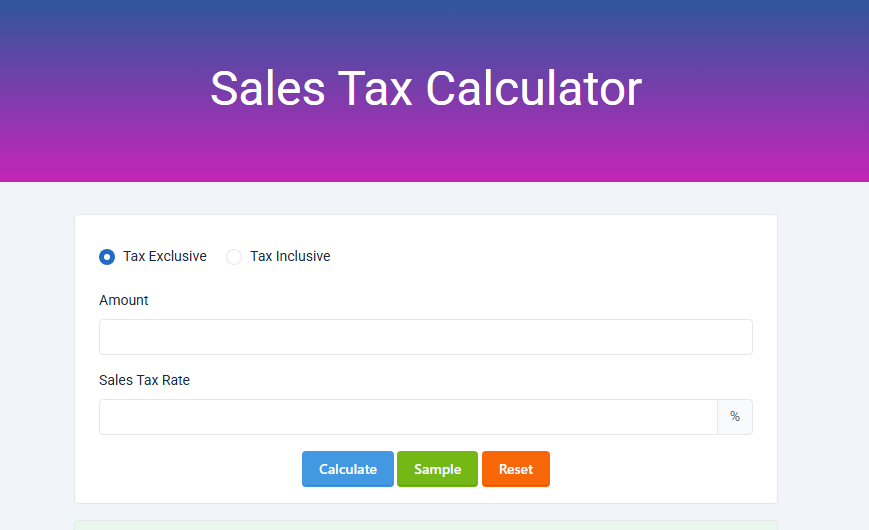
The OKemall Sales Tax Calculator lets you enter an amount and a sales tax rate, then calculate the applicable tax and total. It also supports Tax Exclusive and Tax Inclusive calculations, which are useful for different pricing situations.
This guide explains how to calculate sales tax, how the sales tax formula works, how to calculate tax backward from a final price, and how to choose the correct calculation method.
Real-World Takeaway: A sales tax calculator performs the arithmetic. It doesn't determine whether a particular product is taxable or which tax rate legally applies. Always verify the applicable rate and tax rules for the relevant location and transaction.
What Is a Sales Tax Calculator?
A Sales Tax Calculator is an online tool that calculates the amount of sales tax added to a purchase and, when applicable, the final price after tax.
The basic sales tax formula is:
Sales Tax = Purchase Price × Sales Tax Rate ÷ 100
For example, if an item costs $200 and the sales tax rate is 7%:
Sales Tax = $200 × 7 ÷ 100
Sales Tax = $14
The final price is:
Final Price = $200 + $14
Final Price = $214
Instead of performing this calculation manually each time, you can enter the amount and tax rate into the OKemall Sales Tax Calculator.
The tool also provides a tax-inclusive calculation mode for situations where the displayed amount already contains sales tax.
How to Use the Sales Tax Calculator
Using a sales tax calculator generally takes only a few seconds.
1. Enter the purchase amount
Start with the price or amount you want to calculate.
For example:
Amount: $500If you're performing a tax-exclusive calculation, this normally represents the price before sales tax.
2. Enter the sales tax rate
Enter the applicable percentage.
For example:
Sales Tax Rate: 8%You can use whole-number or decimal rates when appropriate, such as 5%, 6.5%, 7.25%, or 8.875%.
3. Choose the calculation type
The OKemall tool provides two options:
-
Tax Exclusive
-
Tax Inclusive
The correct choice depends on whether your starting amount already includes sales tax.
4. Calculate the result
The calculator determines the tax amount and relevant total based on the information entered.
5. Check the result
For everyday calculations, you're usually ready to use the result.
For accounting, invoicing, or tax compliance, verify the rate and applicable tax rules separately.
Sales Tax Formula
The standard formula for calculating sales tax is simple.
Sales Tax Formula
Sales Tax = Original Price × Tax Rate ÷ 100
Suppose:
-
Original price = $750
-
Sales tax rate = 6%
Then:
Sales Tax = $750 × 6 ÷ 100
Sales Tax = $45
The final price becomes:
Final Price = $750 + $45
Final Price = $795
So the customer would pay $795, assuming the $750 amount is taxable and the 6% rate applies to the entire amount.
How to Calculate Sales Tax Manually
You don't need a calculator to understand the mathematics.
Take the purchase amount and multiply it by the tax percentage.
For example:
Price = $100
Tax Rate = 8%

$100 × 8% = $8
Then add the tax:
$100 + $8 = $108The sales tax is $8, while the total price is $108.
The same process works for larger amounts.
Example: $1,500 at 8%
$1,500 × 8 ÷ 100 = $120Therefore:
Original price = $1,500
Sales tax = $120
Final price = $1,620
The formula doesn't change as the transaction gets larger.
Only the numbers change.
How to Calculate Sales Tax on $100
The amount of tax on $100 depends entirely on the tax rate.
| Sales Tax Rate | Tax on $100 | Total Price |
|---|---|---|
| 3% | $3 | $103 |
| 4% | $4 | $104 |
| 5% | $5 | $105 |
| 6% | $6 | $106 |
| 7% | $7 | $107 |
| 7.5% | $7.50 | $107.50 |
| 8% | $8 | $108 |
| 9% | $9 | $109 |
| 10% | $10 | $110 |
| 15% | $15 | $115 |
| 18% | $18 | $118 |
This is why entering the correct tax rate is essential.
A calculator can accurately calculate 8%.
It can't know whether 8% is the correct rate for your particular transaction.
How to Calculate Tax-Inclusive Prices
A tax-inclusive price already contains sales tax.
This changes the calculation.
Suppose the total price is $108, and the sales tax rate is 8%.
You cannot simply calculate 8% of $108 and treat that as the included tax.
Instead, use:
Pre-Tax Price = Tax-Inclusive Price ÷ (1 + Tax Rate ÷ 100)
So:
Pre-Tax Price = $108 ÷ 1.08
Pre-Tax Price = $100
Then calculate the tax component:
Sales Tax = $108 - $100
Sales Tax = $8
The breakdown is:
| Amount | Value |
|---|---|
| Pre-tax price | $100 |
| Included sales tax | $8 |
| Final price | $108 |
This is the purpose of a Tax Inclusive calculation.
Tax Inclusive vs. Tax Exclusive
Understanding these two terms prevents many calculation errors.
| Feature | Tax Exclusive | Tax Inclusive |
|---|---|---|
| Starting amount | Before tax | Already includes tax |
| Tax | Added to amount | Extracted from total |
| Common use | Adding tax to a listed price | Finding tax within a final price |
| Basic formula | Price × rate | Total ÷ (1 + rate) |
| Example at 8% | $100 → $108 | $108 → $100 before tax |
Tax Exclusive Example
A product costs $400 before tax.
Tax rate:
8%Tax:
$400 × 8% = $32Total:
$400 + $32 = $432Tax Inclusive Example
A receipt shows a final price of $432, including 8% tax.
Pre-tax amount:
$432 ÷ 1.08 = $400Included tax:
$432 - $400 = $32The same transaction can therefore be calculated in either direction.
How to Calculate Sales Tax Backward
Reverse sales tax calculations are useful when you know the final amount but need to identify the original price.
The formula is:
Original Price = Final Price ÷ (1 + Tax Rate ÷ 100)
Suppose a purchase totals $1,070 and includes 7% sales tax.
Original Price = $1,070 ÷ 1.07
Original Price = $1,000
Then:
Sales Tax = $1,070 - $1,000
Sales Tax = $70
So:
-
Original price: $1,000
-
Sales tax: $70
-
Final price: $1,070
This calculation is especially useful when reviewing tax-inclusive receipts and invoices.
Sales Tax Calculator Examples
Example 1: $50 at 5%
Price = $50
Tax Rate = 5%

Tax = $50 × 5 ÷ 100
Tax = $2.50
Final price:
$50 + $2.50 = $52.50Sales tax: $2.50
Final price: $52.50
Example 2: $250 at 6%
Price = $250
Tax Rate = 6%

Tax = $250 × 6 ÷ 100
Tax = $15
Final price:
$250 + $15 = $265Sales tax: $15
Final price: $265
Example 3: $999 at 7.5%
Price = $999
Tax Rate = 7.5%

Tax = $999 × 7.5 ÷ 100
Tax = $74.925
Rounded to two decimal places:
Sales tax = $74.93
Final price:
$999 + $74.93 = $1,073.93For currency calculations, rounding rules can matter, particularly in business accounting systems.
Example 4: $2,500 at 8.25%
Price = $2,500
Tax Rate = 8.25%

Tax = $2,500 × 8.25 ÷ 100
Tax = $206.25
Final price:
$2,500 + $206.25 = $2,706.25This example shows why a calculator becomes useful when tax rates contain decimal values.
Why Use an Online Sales Tax Calculator?
Manual sales tax calculations are easy when you're working with round numbers.
The situation changes when you're checking multiple prices, decimal rates, or larger transactions.
An online calculator provides several practical advantages.
Faster calculations
You don't need to write the formula every time.
Fewer arithmetic errors
The calculation is performed consistently.
Useful for decimal rates
Rates such as 7.25% or 8.875% can be calculated quickly.
Easy price checking
You can verify the expected total before completing a transaction.
Helpful for invoices
Businesses can use a calculator to perform quick mathematical checks.
Useful on mobile
A browser-based calculator can be used from a phone, tablet, or computer.
The OKemall Sales Tax Calculator is designed as an online calculation tool with custom tax-rate input and both tax-exclusive and tax-inclusive options.
Sales Tax Calculator for Online Shopping
Online shopping can make tax calculations confusing because the product price displayed on a product page may not always represent the final checkout amount.
Suppose a product is listed at:
$300The applicable sales tax rate is:
7.5%The tax is:
$300 × 7.5 ÷ 100 = $22.50The estimated total is:
$300 + $22.50 = $322.50That gives you a quick estimate.
However, the final checkout amount may also contain shipping charges, discounts, fees, or other transaction-specific adjustments.
Don't assume every difference between the listed price and checkout total is sales tax.
Sales Tax Calculator for Businesses
Businesses have a different requirement.
The calculation must fit into a broader accounting process.
A business may need to consider:
-
Taxable and non-taxable products
-
Customer location
-
Seller location
-
Applicable jurisdiction
-
Local tax rules
-
Exempt transactions
-
Discounts
-
Returns
-
Tax rounding
-
Marketplace transactions
-
Invoices and receipts
A simple calculator handles the arithmetic.
It doesn't replace tax-compliance software or professional tax advice.
For example, if a retailer enters 10% into a calculator, the calculator can accurately calculate 10%.
It doesn't establish that 10% is the correct rate.
That distinction matters when money, invoices, and compliance are involved.
Real-World Takeaway: Use an online sales tax calculator as a calculation tool, not as a tax-law database. Verify the applicable rate before using the result for a real business transaction.
Sales Tax Calculator for Invoices and Receipts
A sales tax calculator can also help when reviewing invoices.
Suppose an invoice shows:
Subtotal: $2,000
Tax rate: 7.5%
Calculate:
$2,000 × 7.5 ÷ 100 = $150The expected total is:
$2,000 + $150 = $2,150You can then compare those numbers against the invoice.
This is particularly useful when checking manually prepared quotations or simple invoices.
For large organizations, automated accounting systems should generally remain the primary source for financial records because they can incorporate business-specific tax configurations and transaction data.
Sales Tax vs. VAT and GST
Sales tax is not simply another name for every consumption tax.
Sales tax, VAT, and GST can operate under different tax structures depending on the jurisdiction.
| Tax system | General description |
|---|---|
| Sales tax | Often collected on taxable sales to consumers |
| VAT | Value-added tax collected through stages of the supply chain |
| GST | Goods and services tax used in various jurisdictions |
The terminology varies internationally.
The calculation of a percentage may look similar, but the legal and accounting treatment can be substantially different.
For that reason, someone searching for a Sales Tax Calculator shouldn't automatically assume that the result is a VAT or GST calculation.
Is Sales Tax the Same in Every Location?
No.
Sales tax rates and rules can vary between jurisdictions.
In the United States, for example, state and local governments can impose different sales taxes. The IRS explains that state and local tax systems can differ and that taxpayers should consider the relevant state and local rules.
This means two purchases with the same pre-tax price can produce different tax amounts when different tax rates apply.
For example:
| Purchase | Tax Rate | Tax | Total |
|---|---|---|---|
| $500 | 5% | $25 | $525 |
| $500 | 7% | $35 | $535 |
| $500 | 8% | $40 | $540 |
| $500 | 10% | $50 | $550 |
The underlying mathematics is identical.
The applicable rate changes the result.
How to Find the Correct Sales Tax Rate
A calculator needs a rate.
Finding the correct rate is a separate task.
Depending on the jurisdiction, useful sources can include:
-
Official government tax websites
-
State or local tax authorities
-
Business tax registration information
-
Accounting or tax professionals
-
Properly configured tax software
Don't rely on a random online percentage simply because it appears in a search result.
Tax rates can change.
Local rules can differ.
Product taxability can also vary.
For business transactions, use an authoritative source appropriate to the jurisdiction involved.
Common Sales Tax Calculation Mistakes
Using the wrong tax rate
This is the most obvious error.
Even perfect arithmetic produces the wrong result when the input rate is wrong.
Applying tax to the wrong amount
A discount, exemption, shipping charge, or other transaction component may affect the taxable base depending on the applicable rules.
Treating a tax-inclusive price as tax-exclusive
This causes the tax to be overstated.
Forgetting decimal percentages
A rate of 7.5% isn't the same as 75%.
Rounding too early
Rounding intermediate calculations can produce different totals in some circumstances.
Removing tax from a final price incorrectly
Simply subtracting the tax percentage from a tax-inclusive total doesn't correctly identify the pre-tax amount.
Use the reverse formula instead.
Sales Tax Calculator Formula Cheat Sheet
Keep these formulas handy.
Calculate sales tax
Tax = Price × Rate ÷ 100
Calculate final price
Total = Price + Tax
Calculate final price directly
Total = Price × (1 + Rate ÷ 100)
Calculate pre-tax price from a tax-inclusive total
Pre-Tax Price = Total ÷ (1 + Rate ÷ 100)
Calculate included tax
Included Tax = Total − Pre-Tax Price
These formulas cover the most common basic sales-tax calculations.
Sales Tax Calculator Quick Reference
| You know | You want | Formula |
|---|---|---|
| Pre-tax price + rate | Tax | Price × Rate ÷ 100 |
| Pre-tax price + rate | Final total | Price × (1 + Rate ÷ 100) |
| Final total + rate | Pre-tax price | Total ÷ (1 + Rate ÷ 100) |
| Final total + pre-tax price | Tax | Total − Pre-tax Price |
This table is useful when deciding which calculation mode to use.
When Should You Use a Sales Tax Calculator?
Use a sales tax calculator when you need a quick answer to a straightforward percentage calculation.
It's useful for:
-
Checking an online purchase
-
Estimating a final price
-
Reviewing an invoice
-
Calculating tax on a product
-
Learning percentage calculations
-
Comparing tax-inclusive and tax-exclusive prices
-
Checking a receipt
-
Preparing a basic estimate
-
Verifying arithmetic
For complex business tax situations, use the calculator alongside the appropriate accounting, tax, or compliance resources.
Frequently Asked Questions About Sales Tax Calculators
What is a Sales Tax Calculator?
A Sales Tax Calculator is an online tool that calculates sales tax from a purchase amount and tax percentage and can determine the resulting total.
How do I calculate sales tax?
Multiply the taxable amount by the sales tax rate and divide by 100.
Example: $500 × 8 ÷ 100 = $40.
How do I calculate the total price with sales tax?
Add the sales tax to the original price.
For a $500 purchase with $40 tax:
$500 + $40 = $540.
What is a tax-exclusive price?
A tax-exclusive price is an amount before sales tax has been added.
What is a tax-inclusive price?
A tax-inclusive price already contains the applicable sales tax.
How do I remove sales tax from a total?
Divide the tax-inclusive total by:
1 + tax rate ÷ 100
For example, with an 8% rate:
Total ÷ 1.08
How much is 7.5% sales tax on $1,000?
The tax is:
$1,000 × 7.5 ÷ 100 = $75
The total is $1,075.
How much is 8% sales tax on $100?
The sales tax is $8, making the total $108.
Can I use a decimal sales tax rate?
Yes. Rates such as 6.5%, 7.25%, and 8.875% can be calculated using the same basic formula.
Does a sales tax calculator know my local tax rate?
A general calculator usually applies the percentage you enter. It doesn't automatically establish whether that percentage is legally applicable to your transaction.
Is sales tax the same as VAT?
No. Sales tax and VAT are different tax systems, although both can involve percentage-based consumption taxes.
Can businesses use a sales tax calculator?
Yes. It can be useful for quick calculations and verification, but businesses should rely on appropriate accounting and tax systems for compliance and official records.
Is the OKemall Sales Tax Calculator free?
The OKemall tool is presented as a free online calculator that doesn't require registration and supports custom sales-tax rates along with tax-inclusive and tax-exclusive calculations.
Calculate Sales Tax Online
Sales tax calculations don't have to be complicated.
If you know the purchase amount and applicable tax rate, the basic calculation is:
Sales Tax = Amount × Tax Rate ÷ 100
If you need the final price:
Total = Amount + Sales Tax
If the amount already includes tax, use the tax-inclusive calculation instead.
The OKemall Sales Tax Calculator provides a simple way to perform these calculations online. Enter the amount, provide the sales tax percentage, select the appropriate calculation mode, and review the result.
For everyday purchases, that can take only a few seconds.
For business transactions, use the calculated result as part of a wider verification process and confirm the applicable tax rules separately.
The mathematics is straightforward.
Getting the right tax rate, taxable amount, and calculation method is what makes the result useful.

Popular Tools
Recent Posts